
 Image credit: Pexels
The most current piece in your wardrobe may already be hanging in it. A Banarasi handed down from your mother, a handloom cotton bought for a festival, a Jamdani you have worn exactly twice, none of these needs replacing. What dates a traditional saree is rarely the weave itself; it is everything around it: the drape, the blouse, the shoes, the layer thrown over the top. This guide covers modern ways to style traditional sarees that leave the cloth exactly as the weaver made it, while the frame around it, silhouette, footwear, hair, accessories, speaks the present decade. Nothing here involves cutting, dyeing or permanently altering a saree, which matters when the saree is an heirloom. Modernizing is styling, not surgery, and a handwoven textile deserves that respect.
- Start With the Weave: What Stays Traditional
- Change the Drape, Change the Decade
- Rethink the Blouse
- Layer It: Jackets, Blazers and Capes
- Belt It
- Swap the Footwear
- Jewelry, Bags and Hair: The Finishing Layer
- Which Traditional Sarees Take Modern Styling Best
- Putting It Together: Modern Saree Looks for US Settings
- Frequently Asked Questions
- Conclusion
Start With the Weave: What Stays Traditional
Every look in this guide begins with the same decision: the saree stays classic. A Banarasi keeps its brocade, a Kanjivaram keeps its temple border, a Jamdani keeps the hand-inlaid motifs that earned the weave UNESCO recognition, and a handloom cotton keeps its honest, slightly irregular texture. These are the elements that took a weaver days or weeks to produce, and they are precisely what a mass-made modern outfit cannot imitate. The contemporary part of the outfit is everything you can change in five minutes and reverse in one: how you drape, what you wear under and over it, and what you put on your feet. Think of the saree as the fixed point and style outward from there.
Change the Drape, Change the Decade
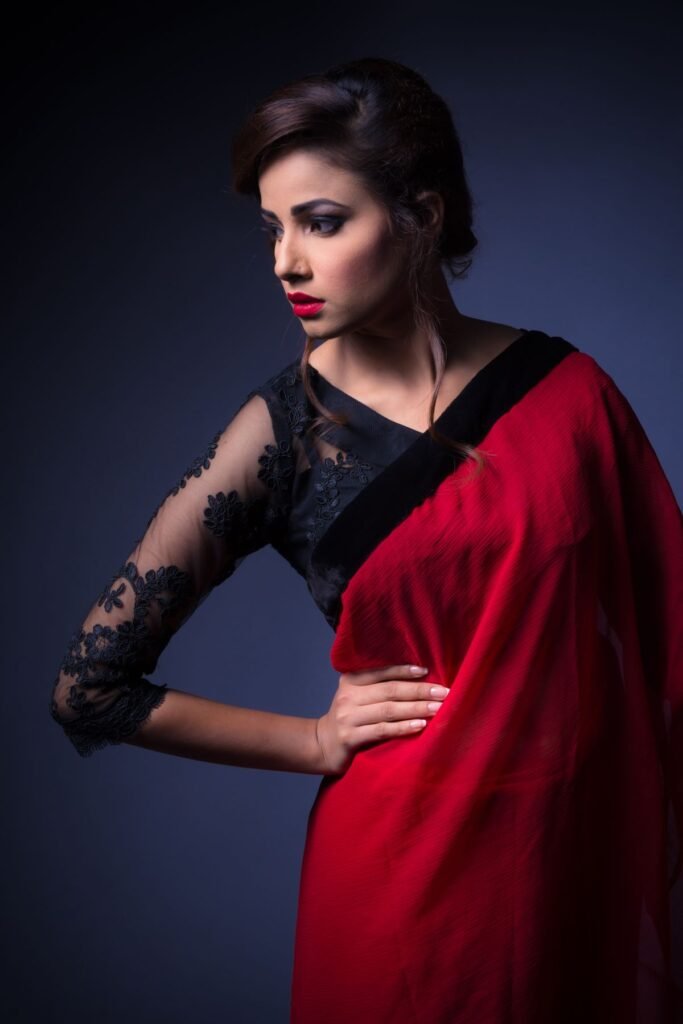
The fastest modernization costs nothing. Take the classic Nivi drape and sharpen it: fewer, narrower pleats pressed flat, and the pallu pinned so it falls in one clean line instead of fanning wide. The same saree instantly reads more tailored. From there, four contemporary drapes do most of the work. The belted drape cinches the pallu at the waist and holds the whole silhouette together through a long evening. The pant-style drape, worn over slim trousers or leggings instead of a petticoat, frees your stride and suits fluid fabrics like georgette and chiffon. The dhoti drape is bolder and wonderfully practical for dancing. And the cape drape throws the pallu or a sheer layer over both shoulders for winter evenings. If you want step-by-step versions, our guide to modern saree draping ideas breaks down the newer drapes in detail. One rule: rehearse any new drape at home before its debut, because a drape that needs adjusting every ten minutes stops looking modern very quickly.
Rethink the Blouse
The saree carries the tradition; the blouse is where the century shows. Swapping the matched blouse piece for something unexpected changes the entire register of an outfit. A crisp white or striped shirt, tucked firmly and worn with the collar open, makes a cotton or handloom saree office-ready. A plain fitted tee or crop top turns an everyday cotton into a weekend look. A turtleneck under a silk saree is a genuinely elegant cold-weather move for US winters. A structured corset-style or high-neck blouse gives an evening drape architectural lines. Keep the fit impeccable, a modern blouse swap fails on a sloppy fit faster than on a bold idea, and let the blouse be plain when the saree’s border and pallu are busy. Browsing the necklines and sleeve shapes in our roundup of the latest saree blouse designs shows which contemporary cuts are actually being worn right now.
Layer It: Jackets, Blazers and Capes
A layer over the drape is the single most “styled” move available, and it solves American weather at the same time. A denim jacket dropped over the shoulders of a handloom cotton saree is a proven cool-evening look, keep it cropped or open so the drape stays visible. A tailored blazer over a silk-cotton or plain silk saree reads boardroom-appropriate and is the easiest route into office wear. A long jacket or sheer cape worn open over a Banarasi adds evening drama without touching the weave. The layer should frame the saree, never bury it: if the pallu and border disappear under the layer, the outfit has lost its point.
Belt It
A belt does three jobs at once: it secures the pallu, defines the waist, and signals that the look was assembled on purpose. Match the belt to the saree’s weight. Slim leather in tan or black suits cotton and linen; metallic or embellished belts sit better on silk and georgette; and if a Western belt feels abrupt against an heirloom weave, use a kamarbandh, the traditional waist chain was doing this job centuries before belts arrived, and it keeps the whole outfit inside the saree’s own vocabulary. Wear it at the natural waist, over the pallu, and let the pleats fan below it.

Swap the Footwear
Shoes set the era of an outfit faster than jewelry does. Block heels are the safe modern default, stable on grass and gravel, clean under pleats, and comfortable through a long reception. White sneakers under a cotton or linen saree are a genuine look rather than a stunt, provided the hem sits at the ankle so the shoe reads as a deliberate choice. Ankle boots pair surprisingly well with pant-style and dhoti drapes in fall. What to avoid: stilettos at outdoor US venues, where lawns and gravel paths punish them, and any shoe so ornate it competes with a heavy border.
Jewelry, Bags and Hair: The Finishing Layer
Modern finishing follows one rule: edit. Choose one statement, a sculptural earring, a choker, or a stack of bangles, and let everything else go quiet. A full bridal jewelry set over a modernized drape pulls the look straight back into costume territory. Swap the traditional potli for a structured clutch or small handbag, add a watch, and the outfit lands in the present. Hair follows the same logic: a sleek low bun, loose waves or a clean ponytail all read current, while heavily pinned ceremonial styles belong with classic drapes. Makeup works best with a single focal point, a defined eye or a strong lip, not both, and a small bindi remains a lovely option rather than an obligation.
Which Traditional Sarees Take Modern Styling Best
Not every weave wants the same amount of experimentation. Use this as your guide:
| Saree | Room to experiment | What works |
|---|---|---|
| Handloom cotton, Tangail, linen | Most | Sneakers, shirts, tees, denim jackets, bold drapes, everyday weaves take the boldest framing. |
| Jamdani | Moderate | Belts and structured blouses; keep the drape airy so the inlaid motifs stay visible. |
| Banarasi | Light touch | Modernize the frame, blouse cut, sleek hair, one statement earring, and keep the drape classic. |
| Kanjivaram | Light touch | A contemporary contrast blouse is enough; the temple border is the statement. |
| Heavy bridal or heirloom silk | Keep classic | Styling changes only, hair, jewelry, bag. Nothing pinned through fragile zari, nothing altered. |
The pattern is simple: the more labor in the weave, the quieter the styling around it should be. Everyday cottons are your playground; heirlooms are your gallery pieces.
Putting It Together: Modern Saree Looks for US Settings
An office or corporate event: a cotton or silk-cotton saree in a Nivi drape, worn with a shirt or high-neck blouse, a blazer over the shoulders, block heels and a watch. It reads as a sharp tailored outfit that happens to be a saree. A gallery opening or museum evening: a silk saree with a long jacket or cape, one sculptural earring and a structured clutch, the weave does the talking in a room full of minimal black. A fusion wedding, where one partner’s family is South Asian and the other’s is not: a Banarasi with a belt and sleek hair bridges both dress codes gracefully, festive without feeling like a costume to anyone. A weekend brunch or campus event: handloom cotton, a tee or crop top, sneakers and sunglasses, the saree as ordinary, joyful clothing, which is ultimately the most modern statement of all.
Frequently Asked Questions
Q: Can I wear sneakers with a traditional saree?
Yes, with the right saree. White sneakers work best under cotton, linen and other everyday handloom weaves, with the hem at the ankle so the shoe looks intentional. For silk sarees and formal occasions, block heels remain the better choice, since the shine of silk asks for a slightly dressier shoe.
Q: Is it disrespectful to style a traditional saree in a modern way?
No. Styling around a saree, changing the drape, blouse, shoes or layers, honors the weave by keeping it in regular use. Respect is about how you treat the textile itself: wear it, care for it, and avoid cutting or permanently altering pieces with heritage or sentimental value.
Q: What is the easiest modern update for a Banarasi saree?
Change the frame, not the drape. A structured contrast blouse, sleek hair, and one contemporary piece of jewelry will move a Banarasi into the present without touching its classic silhouette. A slim metallic belt over the pallu is the next step if you want one more modern note.
Q: How do I wear a saree to an American office event?
Choose a cotton or silk-cotton saree in a neat Nivi drape, pin the pleats and pallu so nothing needs adjusting, and pair it with a shirt or high-neck blouse. A blazer and block heels complete a look that reads professional in any US workplace setting.
Q: Should I alter an heirloom saree to make it look modern?
We advise against it. Cutting, converting or permanently restitching an heirloom saree destroys exactly what makes it valuable, and every modern effect in this guide, drapes, belts, layers, blouse swaps, is fully reversible. Style around the heirloom; do not rebuild it.

Conclusion
A traditional saree does not need to be replaced to look modern; it needs to be reframed. Keep the weave exactly as it is, and change the things that carry a date, the drape’s sharpness, the blouse’s cut, a belt, a jacket, the shoes, a single piece of jewelry. Start with your everyday cottons, experiment freely, and give your Banarasi and heirloom silks a lighter hand. Worn this way, a saree your grandmother would recognize becomes an outfit that belongs entirely to you, and entirely to now.