
 Image credit: Pexels
A saree already carries color, weave and border work, so the jewelry you add can either complete the picture or compete with it. Learning how to style saree with jewelry is less about owning more pieces and more about choosing the right ones in the right order: one statement first, then the metal, then the neckline, then everything else. This guide walks through that order step by step, for every kind of saree, handloom cotton for a weekday, silk for a wedding, sequined georgette for a party, and for the way sarees are actually worn in the US, from office days to evening receptions. No new purchases are assumed; most of the combinations below can be built from pieces you probably already own.
- The One-Statement Rule: Pick Your Focal Point First
- Match the Metal to the Zari and Embellishment
- Match the Necklace to Your Blouse Neckline
- Earrings: Balance Face, Hair and Fabric Weight
- Bangles and Bracelets: The Finishing Layer
- Four Jewelry Styles, and the Sarees They Love
- Scale It Down: Daytime and Office Wear in the US
- Five Common Jewelry Mistakes to Avoid
- Frequently Asked Questions
- Conclusion
The One-Statement Rule: Pick Your Focal Point First
Every well-styled saree look has exactly one star. It might be a choker, a pair of chandelier earrings, a long temple necklace or a stack of bangles, but only one of them gets to be loud. Everything else plays a supporting role: smaller, simpler and in the same metal family.
The rule works because a saree is not a plain backdrop. The border, the pallu and the blouse already create lines and shine near your face and hands. When a heavy necklace, heavy earrings and heavy bangles all arrive at once, the eye does not know where to land, and each piece makes the others look cheaper. Try the pairings this rule produces:
- Statement necklace: pair it with studs or small drops and one or two plain bangles.
- Statement earrings: skip the necklace entirely, or wear the thinnest chain you own, and let the wrists carry a modest stack.
- Statement bangles: keep the neck and ears quiet, a fine pendant and small hoops are plenty.
- Heavily worked saree: the saree itself is the statement, so all the jewelry steps down a size.
Decide the focal point before you open the rest of the jewelry box. It is the single decision that makes the rest of this guide fall into place.
Match the Metal to the Zari and Embellishment
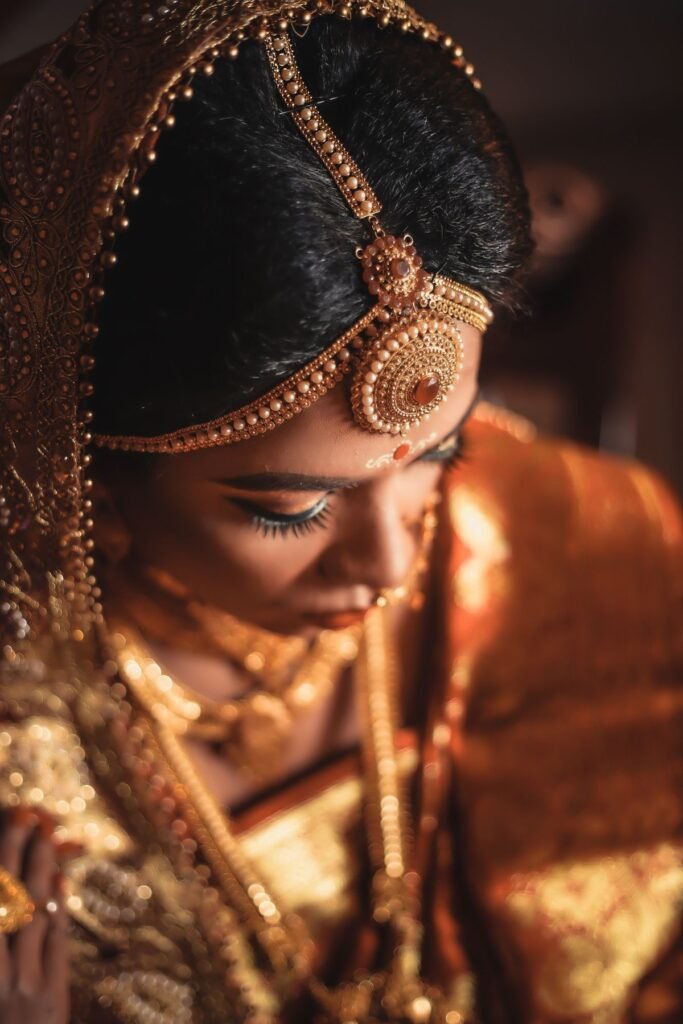
After the focal point, the fastest way to make a look feel right is to echo the metal already in the saree. Most saree embellishment falls into one of three families, and each one points to a jewelry metal:
- Gold zari and gold embroidery call for gold jewelry, yellow gold, antique-finish gold or gold-toned temple pieces. Zari is the metallic thread woven into borders and motifs, and when its warm tone is repeated at the neck and ears, the whole outfit reads as one piece.
- Silver zari, white threadwork and cool-toned borders pair with silver, bright silver, white metal or oxidized silver, whose darkened finish flatters handloom textures especially well.
- Sequins, crystals and stone work pair with crystal, cubic zirconia or American-diamond-style pieces that repeat the sparkle rather than introducing a second metal color.
What about a plain saree with no metallic work at all? Then the fabric color decides: warm colors such as red, maroon, mustard and bottle green lean gold; cool colors such as blue, grey, black, white and pastels lean silver. Mixing metals is not forbidden, many women layer a gold chain with silver jhumkas successfully, but with a saree it usually reads as an accident rather than a choice. Pick one metal family per outfit and let every piece agree with it.
Match the Necklace to Your Blouse Neckline
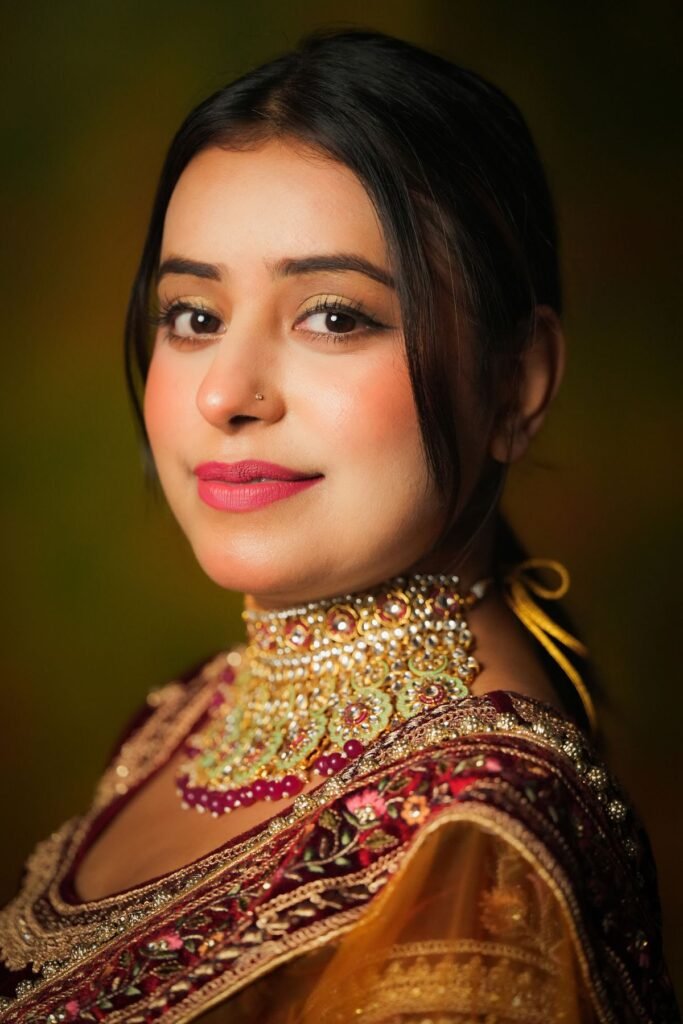
Necklaces fail more often because of the blouse than because of the saree. A necklace should sit on bare skin, clear of the blouse edge and the border, and its shape should echo the shape of the neckline:
| Blouse neckline | Best necklace | Why it works |
|---|---|---|
| Round or U-neck | Short necklace or choker following the curve | Fills the open space without touching the blouse edge |
| V-neck | Pendant or V-shaped necklace | The point of the pendant echoes the point of the neckline |
| Square neck | Compact choker or structured collar | Mirrors the straight lines and corners of the neckline |
| Sweetheart or wide neck | Choker or bib necklace | Covers the broad open area evenly |
| Boat neck | Choker above the edge, or a long necklace below it | Keeps the necklace off the wide horizontal border line |
| High neck or collar | No necklace, statement earrings instead | There is no bare skin for a necklace to sit on |
| Deep neck | Layered choker plus a longer chain | The extra space can carry two lengths without crowding |
One practical check: the necklace should end clearly above the neckline, rest inside it, or fall clearly below it. A pendant that lands exactly on the blouse edge looks undecided and keeps catching on the fabric all evening.
Earrings: Balance Face, Hair and Fabric Weight
Earrings are the hardest-working jewelry you own, because they frame the face in every photograph. Choose them in this order: face and hairstyle first, fabric weight second.
Long faces gain balance from wider styles, chandbalis, round jhumkas and studs with presence, while round faces look longer with drops and elongated shapes. If your hair is worn up, earrings become the main event near the face and can go bigger; loose hair hides all but the ends of long earrings, so with hair down, either choose pieces long enough to show or switch the statement to the neck. Short hair and neat buns show studs beautifully, which is why a simple pearl or gold stud looks so sharp with a formal drape.
Fabric weight sets the ceiling. Heavy silk and brocade can carry large jhumkas and chandeliers without being upstaged. Light chiffon, georgette and soft cotton are easily overwhelmed, a giant earring on a floaty saree makes the whole outfit look top-heavy, so stay with medium drops, hoops or studs. And remember the one-statement rule: the bigger the earrings, the quieter the necklace.
Bangles and Bracelets: The Finishing Layer
Bangles are where tradition and practicality meet. The classic pairing is a set matched to the saree’s border or blouse color, worn on one or both wrists; the modern shortcut is a single metal kada or a slim bracelet stack in the outfit’s chosen metal.
- Silk and wedding sarees: gold bangles, plain or with fine texture, on both wrists, the traditional full look.
- Cotton and handloom: glass bangles in a border color, oxidized silver bangles, or a mix of thin metal and thread-wrapped pieces.
- Party and evening sarees: crystal or stone-studded bangles on one wrist, leaving the other bare or with a watch.
- Everyday and office: one kada, a slim bracelet or just a watch, enough to finish the wrist without noise when you type or gesture.
Two small cautions: very wide stacks can snag a delicate pallu when you adjust your drape, and metal bangles against a sequined blouse wear the sequins down over time. When in doubt, move the stack to the wrist opposite your pallu hand.
Four Jewelry Styles, and the Sarees They Love
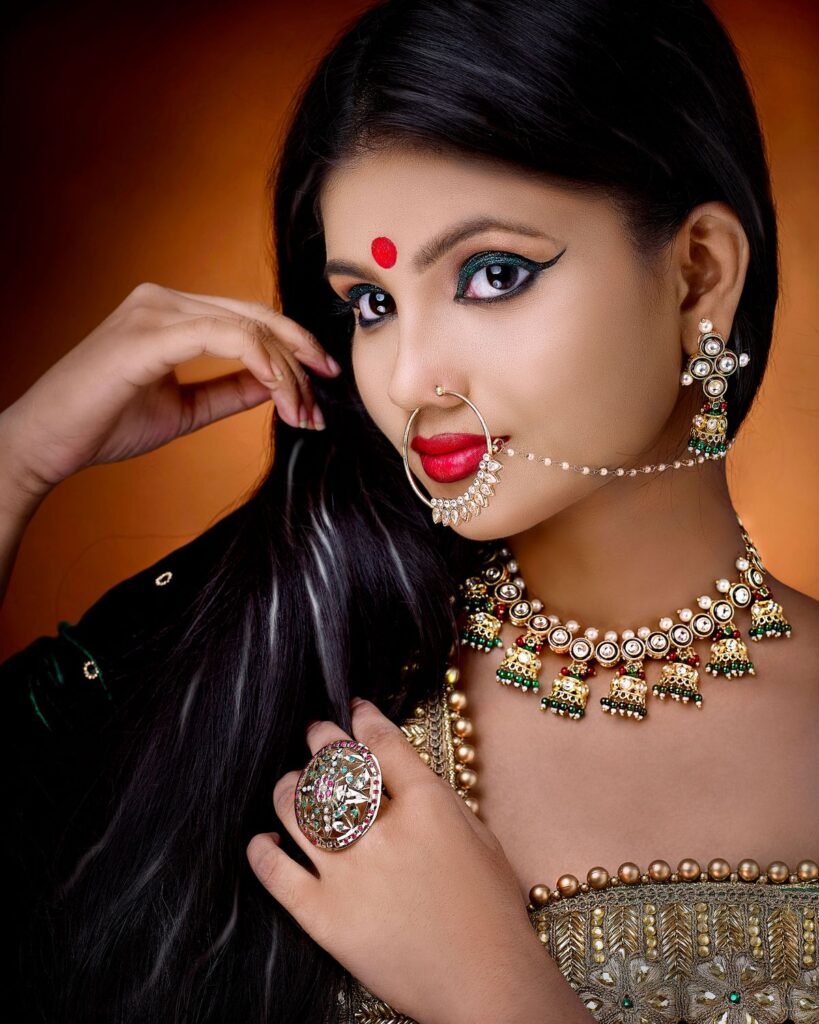
Most saree jewelry in US wardrobes falls into four families. Knowing which family you are wearing, and not drifting between two in one outfit, is most of the battle.
Classic gold. The default for silk. Plain or lightly bordered silks take a full gold set gracefully; if you are choosing among Banarasi, Kanjivaram and other weaves, our overview of the types of silk sarees shows how much zari each carries, which tells you how much gold the look can hold. Heavily woven silks need less: studs, a short chain and bangles.
Temple jewelry. Antique-finish gold with goddess and peacock motifs, born in South India and made for silk. It is the wedding and festival heavyweight, magnificent with a plain or lightly worked silk, too much with an already busy Banarasi. Keep the earrings from the same set and skip extra pieces.
Oxidized silver. The handloom partner. Its dark, matte finish sits perfectly against cotton, linen and tussar textures and earthy colors, and it is light enough for all-day wear. A bold oxidized choker can be the single statement on a plain cotton saree; with silk, use it sparingly and only when the saree’s own work is silver-toned.
Minimalist modern. Fine chains, small hoops, pearl studs, a single cuff. This is the family for chiffon, georgette, organza and contemporary drapes, and for sequined party sarees, where the fabric already sparkles; our guide on how to style a saree for a party shows how to build the rest of that look around understated jewelry. Crystal drops belong in this family too, whenever the saree’s work is sequins or stones.
Scale It Down: Daytime and Office Wear in the US
Many women in the US wear sarees to the office, to school events and to daytime community gatherings, where the goal is polish, not pageantry. The scaling rules are simple. Choose one small statement, most often earrings, because they survive video calls and ID-badge photos. Keep necklaces fine and short, or skip them under a modest neckline. Swap the bangle stack for a watch and one kada, so your wrists stay quiet at a keyboard. Prefer matte and oxidized finishes or small pearls over high-shine sets, which read as evening wear under office lighting. A cotton or linen saree with oxidized studs, a slim watch and neat pleats looks intentional and professional anywhere in the US, and the same saree can be re-styled for the evening in five minutes by changing only the earrings and adding a choker.
Five Common Jewelry Mistakes to Avoid
- A heavy necklace over a heavy border. When the pallu border is wide and rich, a big necklace lands on top of it and both lose. Let the border be the frame and wear earrings instead.
- Mismatched metals. Gold zari with silver jewelry, or the reverse, makes both look accidental. Match the metal family to the saree’s work first.
- Over-accessorizing a worked saree. Sequins, embroidery and brocade are already jewelry woven into cloth. Adding a full set on top turns richness into noise.
- A necklace resting on the blouse edge. A chain that sits exactly on the neckline border catches, twists and looks unfinished. Move it up, in or down.
- Two statements at once. An ornate back-neck blouse is designed to be the feature; pairing it with heavy front jewelry creates a second, competing feature. Let one side win.
Frequently Asked Questions
Q: Can I mix gold and silver jewelry with one saree?
You can, but it is the hardest look to pull off. Mixed metals work when one clearly dominates, say, a gold set with a single silver-toned watch, and fail when the pieces are equal in size and shine. With a saree, the safer rule is to match your jewelry to the metal in the saree’s zari or embroidery and keep every piece in that family.
Q: What jewelry goes best with a silk saree?
Gold is the classic answer: a necklace set or temple jewelry for weddings and festivals, scaled down as the silk’s own zari work gets heavier. A plain silk can carry a full set; a richly woven Banarasi or Kanjivaram usually looks best with studs or jhumkas, a short chain and gold bangles.
Q: Should I wear a necklace with a heavily embroidered saree?
Usually no. Embroidery and sequin work around the neckline and pallu already do the necklace’s job. Wear statement earrings and bangles instead, and let the needlework be the focal point. If the embroidery sits only on the body and the neckline is plain, a simple choker is fine.
Q: What jewelry works with a saree at the office?
Small and matte: studs or small drops, a fine short chain or none, and a watch with one slim bangle or kada. Oxidized silver and pearls suit cotton and linen sarees in daylight, and keeping to one small statement keeps the look professional rather than festive.
Q: How do I choose between jhumkas and studs?
Let the necklace decide. With a statement necklace, wear studs; with no necklace or a fine chain, jhumkas can carry the look. Also weigh the fabric: jhumkas suit silk and cotton, while very light chiffon and georgette usually look better with studs or slim drops that do not outweigh the drape.
Conclusion
Styling saree jewelry is a sequence, not a shopping trip: pick one statement, match the metal to the saree’s own work, fit the necklace to the blouse neckline, then let earrings and bangles support rather than compete. Run through those four checks in front of the mirror and almost any saree in your wardrobe, silk, cotton or sequined, will look deliberately, elegantly finished, whether you are dressing for a wedding, a festival or a Tuesday at the office.