
 Image credit: Pexels
Walk into any South Asian clothing store in the US and you will see two very different racks. On one side hang deep red and gold silks with heavy woven borders, the kind of saree that has looked right at weddings for generations. On the other side are feather-light chiffons in blush and sage, sequinned nets, and pre-stitched drapes you can step into like a gown. Both are sarees, but they speak two different fashion languages. Understanding traditional vs modern saree fashion is not about deciding which one wins. It is about learning what each style is actually saying, so you can choose the right language for the occasion, the budget, and your own wardrobe.
- Two Fashion Languages, One Garment
- Fabrics and Weaves: Where the Divide Starts
- Draping Styles: Ritual Order vs Personal Signature
- The Blouse: Supporting Act vs Statement Piece
- Embellishment, Color, and Motif
- Occasions: Where Each Language Belongs
- Care, Longevity, and the Real Cost Logic
- Traditional vs Modern Saree: Side-by-Side
- The Middle Ground: How US Women Actually Wear Both
- How to Choose for Your Wardrobe
- Frequently Asked Questions
- Conclusion
Two Fashion Languages, One Garment
At its core, the sari is a single length of unstitched cloth, usually between five and nine yards, draped around the body and worn with a fitted blouse and an underskirt. That basic structure has not changed in centuries, which is why “traditional” and “modern” are not two different garments. They are two different philosophies applied to the same garment. Traditional saree fashion treats the cloth itself as the artwork: the weave, the border, and the motifs carry the meaning, often tied to a region, a craft community, and a family history. Modern saree fashion treats the saree as a canvas for styling: the cloth is often simpler, and the personality comes from the drape, the blouse, the accessories, and the attitude of the wearer. Neither philosophy is new or old in spirit, because traditional weavers have always experimented and modern designers constantly borrow from heritage looms. The difference is emphasis.
Fabrics and Weaves: Where the Divide Starts
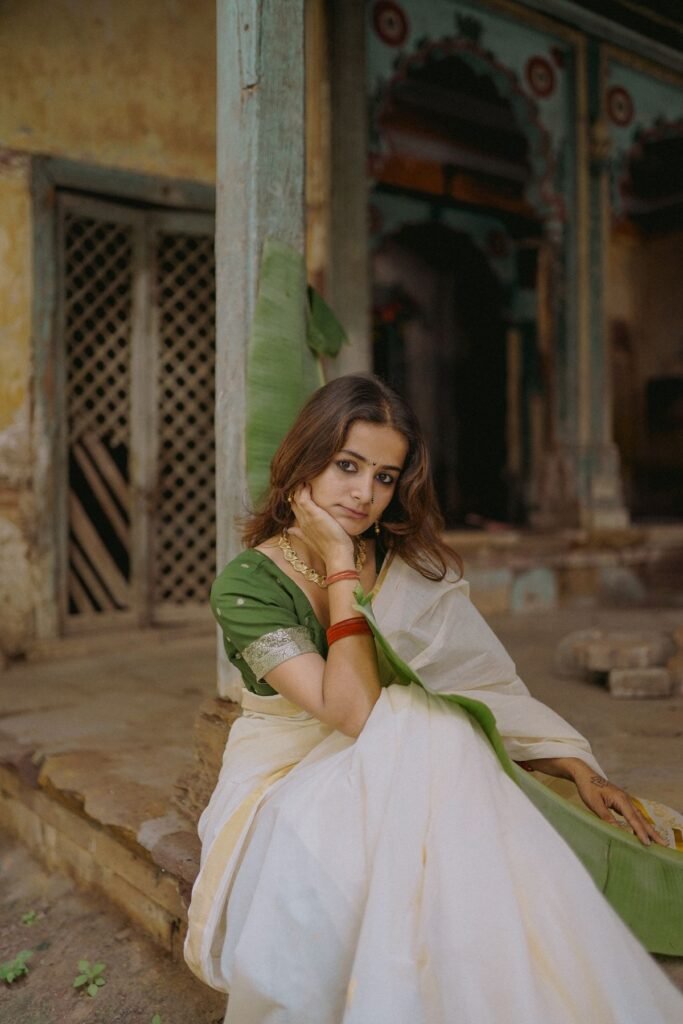
Fabric is the clearest dividing line. Traditional sarees are built on natural fibers and named regional weaves: mulberry silk from Kanchipuram and Banaras, handloom cotton from Bengal and the South, tussar, and fine muslin-style weaves like Jamdani. The decoration is usually woven into the cloth itself. Gold-toned zari thread forms borders and motifs on the loom, so the design and the fabric are one and the same thing. A traditional saree tends to have weight, body, and a certain stiffness that holds pleats crisply.
Modern sarees lean on lightweight and easy-handling fabrics: chiffon, georgette, crepe, organza, net, satin blends, and printed synthetics. Decoration is more likely to be applied on top of the cloth rather than woven into it, through digital prints, machine embroidery, sequins, lace edging, or foil work. The result is a saree that is lighter on the shoulder, easier to carry for long hours, and usually simpler to maintain. The trade-off is that a printed design sits on the surface, while a woven design is the fabric, which is one reason the two age very differently over the years.
Draping Styles: Ritual Order vs Personal Signature
Traditional draping follows established regional forms that have been taught from mother to daughter for generations. The Nivi drape, with its neat front pleats and pallu over the left shoulder, is the most widely recognized, but it is only one of many: the Bengali aatpoure, the Maharashtrian nauvari, the Gujarati seedha pallu, and the South Indian madisar each carry their own logic and occasion. If you want to see how much variety exists inside the traditional world alone, our guide to traditional Indian saree draping styles walks through the major regional drapes and where each one belongs. In traditional fashion, draping “correctly” matters, because the drape itself signals respect for the occasion.
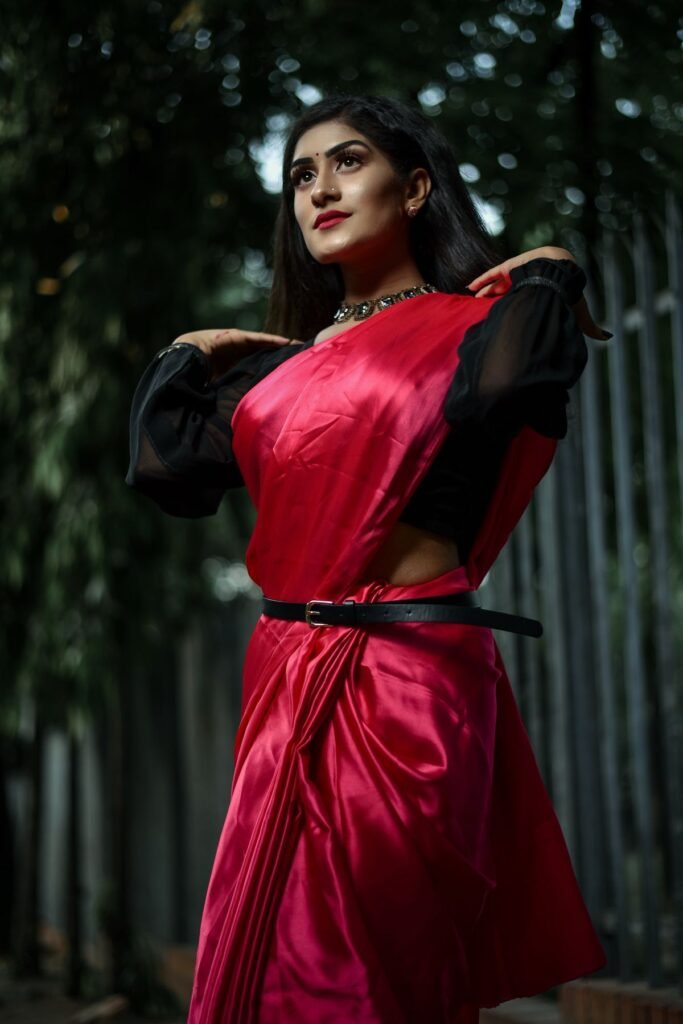
Modern draping treats the six yards as raw material for experimentation. The pallu might be pleated narrow and pinned like a scarf, wrapped around the neck, belted at the waist, or left flowing for movement in photographs. Pre-draped and ready-to-wear sarees take the idea furthest, stitching the pleats in place so the wearer skips the hardest part entirely. In modern fashion, the drape is a personal signature rather than a rule, and “incorrect” mostly means “unintentional.” Both approaches have a learning curve: traditional drapes demand technique, while modern drapes demand confidence.
The Blouse: Supporting Act vs Statement Piece
Nothing reveals the traditional vs modern divide faster than the blouse. In a traditional outfit, the blouse is a supporting act. It is usually tailored from the blouse piece that comes with the saree or a matching silk, cut with modest necklines and elbow-length or three-quarter sleeves, and designed to frame the saree rather than compete with it. Jewelry, not the blouse, provides the ornament.
In modern saree fashion, the blouse often becomes the statement piece. Corset cuts, halters, off-shoulder and backless designs, cape sleeves, jackets, and even structured shirts or fine-knit tops are paired with relatively plain sarees to create the look. This shift matters for your wardrobe math: a traditional saree is a complete, self-sufficient outfit, while a modern look is an assembly. One striking blouse can generate several modern outfits from simple sarees you already own, which is why modern styling can be surprisingly economical even when it looks extravagant.
Embellishment, Color, and Motif
Traditional embellishment is symbolic as much as decorative. Temple borders, paisleys, peacocks, lotus motifs, and checks or stripes specific to a region tell you where a saree comes from and what it is for. The traditional palette runs deep and saturated: maroon, sindoor red, turmeric yellow, emerald, royal blue, and gold. These colors were chosen for ceremony and candlelight, and they photograph with a richness that still feels formal.
Modern embellishment is trend-driven. Digital florals, abstract and geometric prints, ombre shading, sequin scatter, and ruffled or feathered edges come and go with fashion seasons. The modern palette favors pastels, ivory, blush, sage, champagne, metallics, and the occasional dramatic black. Where a traditional saree announces its occasion, a modern saree announces its wearer. Both are valid messages; they are simply addressed to different audiences.
Occasions: Where Each Language Belongs
Traditional sarees remain the default wherever the event itself is traditional: weddings, religious ceremonies, festivals, formal family portraits, and milestone celebrations. In these settings, a heritage weave carries respect and continuity that guests recognize instantly, and an heirloom saree worn from a mother’s or grandmother’s collection adds a layer no new purchase can imitate.
Modern sarees shine where the setting is social rather than ceremonial: cocktail evenings, office parties, receptions with mixed company, date nights, daytime celebrations, and events where you will be on your feet, traveling, or dancing for hours. For US wearers, modern sarees also solve practical problems, from navigating winter coats and car seats to feeling at ease in rooms where most guests are in Western dress. The honest rule is to read the room: the more the event belongs to tradition, the more traditional your saree should be, and the more the event belongs to you personally, the more room you have to experiment.
Care, Longevity, and the Real Cost Logic
Here is the difference most comparison articles skip. A traditional silk or handloom saree is a capital purchase. It costs more upfront because skilled handwork and natural fiber cost more, and it asks for careful handling: gentle or professional cleaning, airing, refolding along different lines, and storage away from moisture. In exchange, it can be worn for decades and handed down, so its cost per wear across a lifetime can be remarkably low.
A modern saree is usually a lower upfront purchase with a shorter expected fashion life. Prints and surface embellishments follow trends, sequins and glued work can tire with repeated cleaning, and lightweight synthetics do not age as gracefully as silk. Care is easier, often a gentle home wash, but the garment is closer to a seasonal outfit than an heirloom. Neither logic is wrong. The mistake is paying heirloom prices for trend construction, or expecting a delicate fashion saree to serve for thirty years. Buy each style for what it actually is.
Traditional vs Modern Saree: Side-by-Side
| Feature | Traditional Saree Fashion | Modern Saree Fashion |
|---|---|---|
| Fabric | Silk, handloom cotton, tussar, Jamdani and other named regional weaves | Chiffon, georgette, crepe, organza, net and printed blends |
| Decoration | Woven into the cloth: zari borders, brocade, handloom motifs | Applied to the cloth: digital prints, sequins, machine embroidery, lace |
| Blouse | Matching, modest cut, supports the saree | Statement piece: corset, halter, jacket, cape or contrasting top |
| Drape | Established regional styles worn in a set way | Experimental, belted, pre-draped or free-flowing |
| Colors | Deep and saturated: maroon, red, emerald, royal blue, gold | Pastels, ivory, metallics, black and seasonal trend shades |
| Best settings | Weddings, pujas, festivals, formal family occasions | Parties, receptions, office events, travel and long evenings |
| Care | Careful: professional cleaning, airing, mindful storage | Easier: often gentle home wash, less storage fuss |
| Longevity | Decades; often becomes an heirloom | Seasonal to a few years of regular wear |
| Price logic | Higher upfront, low cost per wear over a lifetime | Lower upfront, bought for the moment and the trend |
The Middle Ground: How US Women Actually Wear Both
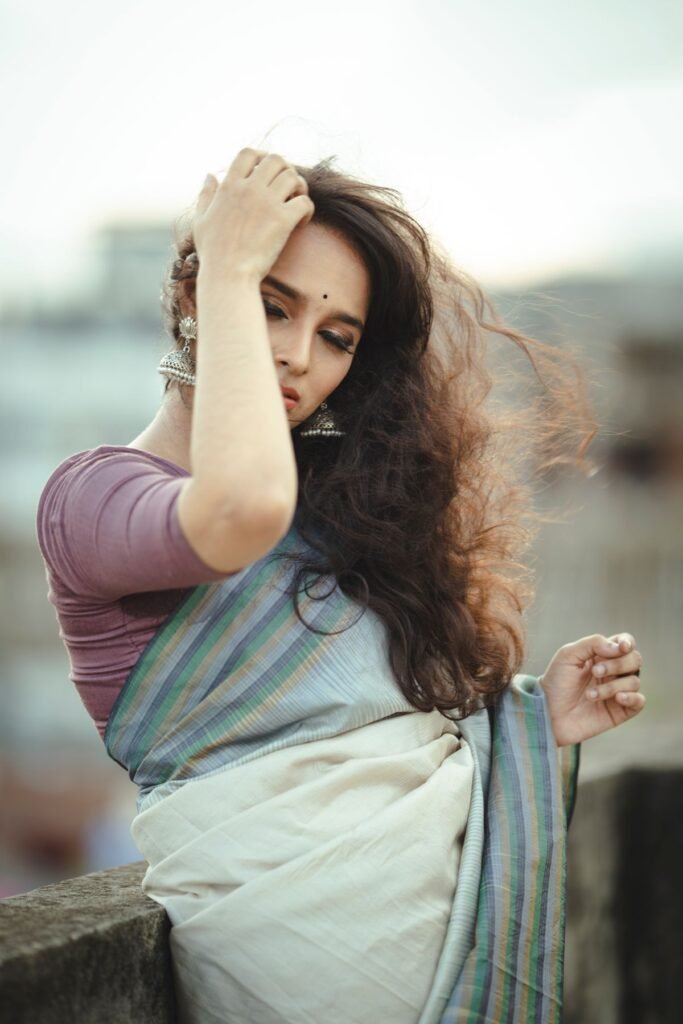
In real American wardrobes, the two languages rarely stay separate. The most common blend is the heirloom remix: a mother’s Banarasi or a handloom Jamdani worn with a sleek, contemporary blouse and minimal jewelry, letting a fifty-year-old weave look completely current. The reverse works too, a simple modern chiffon given weight and ceremony with a traditional drape, temple jewelry, and flowers in the hair. Many women keep one or two traditional anchors for weddings and festivals, then build the rest of their saree wardrobe from lighter modern pieces that can be restyled endlessly with different blouses and belts. If you are building that kind of mixed wardrobe, browsing modern saree draping ideas is a good way to see how a single classic saree can be re-draped into several distinct looks.
How to Choose for Your Wardrobe
Start with your calendar, not your taste. List the occasions you actually attend in a year: if most are weddings, pujas, and festivals, weight your wardrobe traditional; if most are parties, work events, and evenings out, weight it modern. Next, be honest about your draping skill and patience, because a pre-draped modern saree you wear happily beats a magnificent silk that stays in its box. Consider care honestly too: heirloom weaves need storage space, airing, and occasional professional cleaning. Finally, think in anchors and accents. One excellent traditional saree plus a rotation of blouses, and two or three versatile modern sarees, will cover nearly every invitation a US wearer receives, without buying a new outfit for each one.
Frequently Asked Questions
Q: What is the main difference between a traditional and a modern saree?
The main difference is where the design lives. In a traditional saree, the beauty is woven into the fabric itself through regional handloom techniques, zari borders, and classic motifs, and the styling around it stays restrained. In a modern saree, the fabric is often simpler and lighter, and the look is created through styling: an experimental drape, a statement blouse, and contemporary accessories.
Q: Are modern sarees appropriate for weddings and religious ceremonies?
It depends on your role and the setting. As a guest at a wedding reception or sangeet, a well-styled modern saree is completely appropriate. For the main ceremony, a puja, or when you are immediate family, a traditional weave in a classic drape is the safer and more respectful choice, because those moments carry expectations that go beyond personal style.
Q: Which is better for a beginner, a traditional or a modern saree?
Most beginners find modern sarees easier: lightweight georgette or chiffon is forgiving to drape, and pre-draped styles remove the hardest steps entirely. That said, a soft handloom cotton in a traditional drape is also beginner-friendly and teaches real technique. Start with whichever you will actually practice in, and add the other style once your confidence grows.
Q: Do traditional sarees last longer than modern sarees?
Generally, yes. A well-kept silk or handloom cotton saree can be worn for decades because its decoration is part of the fabric’s structure. Modern sarees with prints, sequins, or glued embellishment tend to tire sooner, both physically and fashion-wise. Longevity still depends on care: any saree stored damp or folded on the same creases for years will suffer, whatever its style.
Q: Can I wear a traditional saree in a modern way?
Absolutely, and it is one of the most popular approaches in the US. Pair a traditional silk or Jamdani with a contemporary blouse, a belt, or a jacket, keep the jewelry minimal, and the heirloom weave becomes the statement. The saree keeps its character and craftsmanship; only the styling language changes, which is exactly how traditional garments stay alive in a modern wardrobe.
Conclusion
Traditional vs modern saree fashion is not a contest with a winner. Traditional sarees carry craft, ceremony, and continuity; modern sarees carry ease, experimentation, and personal expression. Most US wearers need both languages: the heirloom silk for the days that belong to family and ritual, and the light, restyleable drape for the days that belong to them. Learn what each style does best, buy each one for what it truly is, and blend them without guilt. That is not fashion indecision. That is fluency.