
 Image credit: Pexels
“Silk saree” is one label for a whole family of very different cloths. A Banarasi and a Kanjivaram are both silk sarees, yet they look, feel and drape almost nothing alike, and a golden Muga from Assam differs from both. The reason is that the names mix two different things: some name a silk fibre (mulberry, tussar, eri, muga), while most name a regional weaving tradition built on one of those fibres. Once you separate the two, the different types of silk sarees fall into place.
This guide walks through the ten types a shopper in the United States is most likely to meet, Banarasi, Kanjivaram, Mysore silk, Tussar, Eri, Muga, Patola, Bandhani silk, Rajshahi silk and silk Jamdani, with where each comes from, what it feels like, and what it is best worn for. For the wider world of sarees beyond silk, see our overview of the different types of sarees.
- First, the Four Silks
- The Major Types at a Glance
- Banarasi, Varanasi, Uttar Pradesh
- Kanjivaram, Kanchipuram, Tamil Nadu
- Mysore Silk, Karnataka
- Tussar, Eastern and Central India
- Eri, Assam and the North East
- Muga, Assam
- Patola, Patan, Gujarat
- Bandhani Silk, the Tie-Dye Tradition
- Rajshahi Silk, Rajshahi, Bangladesh
- Silk Jamdani, Bangladesh and Uppada
- A Word on Labels: Art Silk and “Soft Silk”
- How to Choose Among Them
- Frequently Asked Questions
- Conclusion
First, the Four Silks
Nearly every silk saree is woven from one of four natural silks, each produced by a different silkworm feeding on a different plant:
- Mulberry silk, from the domesticated silkworm Bombyx mori, reared indoors on mulberry leaves. The smoothest, most even and most lustrous silk, and the base of most famous sarees, including Banarasi, Kanjivaram and Mysore silk.
- Tussar (tasar) silk, a wild silk from moths reared outdoors on trees such as asan and arjun in eastern and central India. Coarser and textured, with a soft gleam and natural tones from honey gold to copper.
- Eri silk, from a silkworm fed on castor leaves in Assam and the North East. The cocoon is open at one end and the moth leaves it, so the silk is spun rather than reeled: matte, soft and warm, almost woolly.
- Muga silk, produced only in Assam, from a silkworm fed on som and soalu leaves. Naturally golden, usually woven undyed, and said to grow more lustrous with age.
The Major Types at a Glance
| Type | Origin | Character | Best for |
|---|---|---|---|
| Banarasi | Varanasi, Uttar Pradesh | Mulberry silk with gold and silver zari brocade | Weddings, bridal wear |
| Kanjivaram | Kanchipuram, Tamil Nadu | Heavy mulberry silk, contrast borders, temple motifs | Weddings, ceremonies |
| Mysore silk | Karnataka | Smooth, light mulberry silk, plain body, narrow zari border | Formal and festive wear |
| Tussar | Eastern and central India | Textured wild silk in natural gold and copper tones | Daytime events, festive wear |
| Eri | Assam and the North East | Matte, soft, warm spun silk | Cool-weather and understated wear |
| Muga | Assam | Naturally golden, dense and glossy | Traditional ceremonies |
| Patola | Patan, Gujarat | Double ikat in bold geometric and figurative patterns | Weddings, heritage occasions |
| Bandhani silk | Gujarat and Rajasthan tradition | Hand tie-dyed dotted patterns, often with zari borders | Festivals, celebrations |
| Rajshahi silk | Rajshahi, Bangladesh | Fine, feather-light mulberry silk with a soft sheen | Weddings, formal occasions |
| Silk Jamdani | Bangladesh; also Uppada, Andhra Pradesh | Hand-inlaid motifs floating on a sheer ground | Elegant festive and occasion wear |
Banarasi, Varanasi, Uttar Pradesh
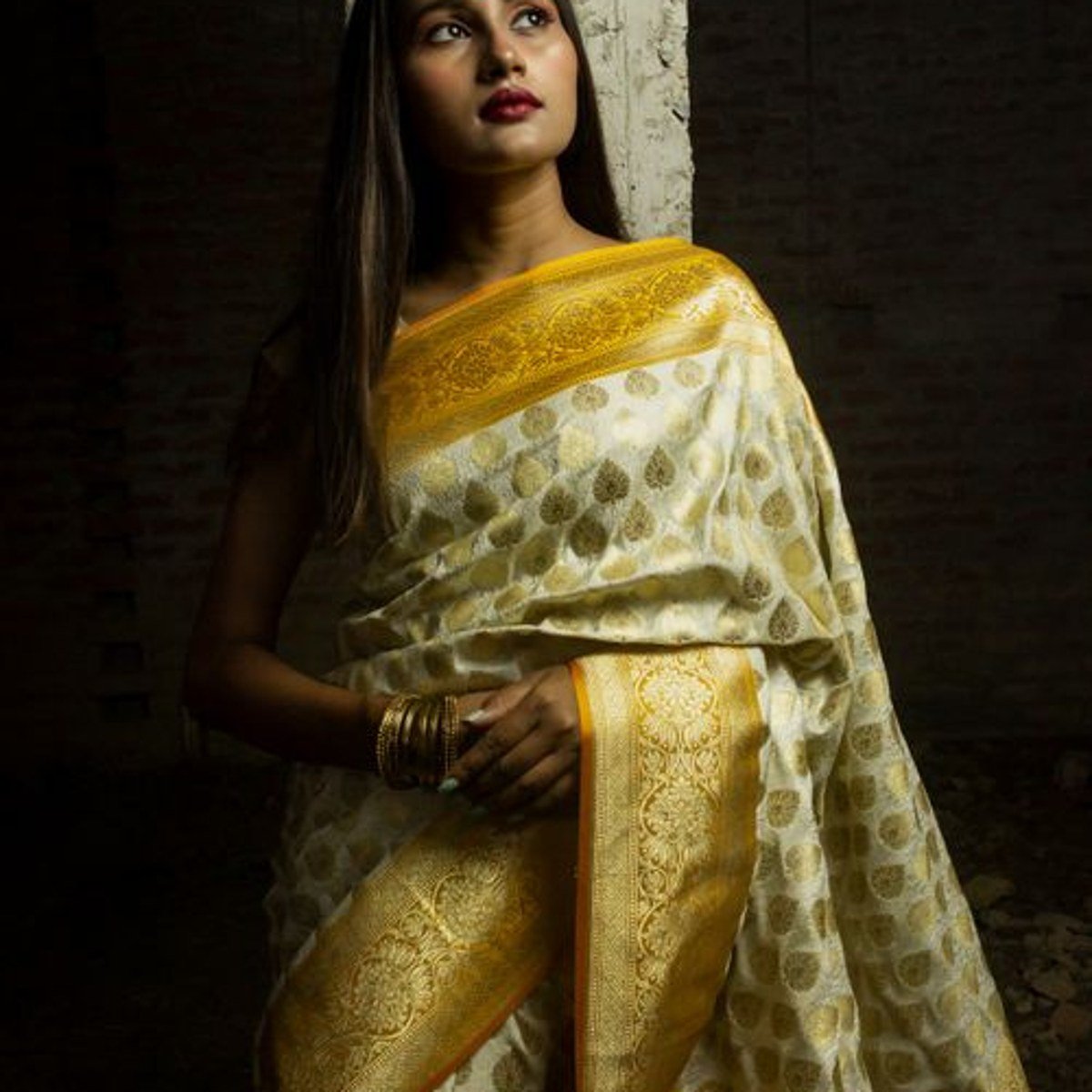
The Banarasi is the silk saree of Varanasi, defined by brocade: gold and silver zari woven directly into a mulberry silk ground, in Mughal-inspired florals, paisleys and vines. The motifs are part of the cloth, never printed or embroidered on top, and a fine piece can take weeks or months at the handloom. “Banaras Brocades and Saris” hold Geographical Indication protection, tying the name to Varanasi and its neighbouring districts, the Banarasi sari is among the most documented of all Indian textiles. Rich, structured and luminous, it remains the default bridal silk of North India and the first choice for weddings and grand festive occasions.
Kanjivaram, Kanchipuram, Tamil Nadu
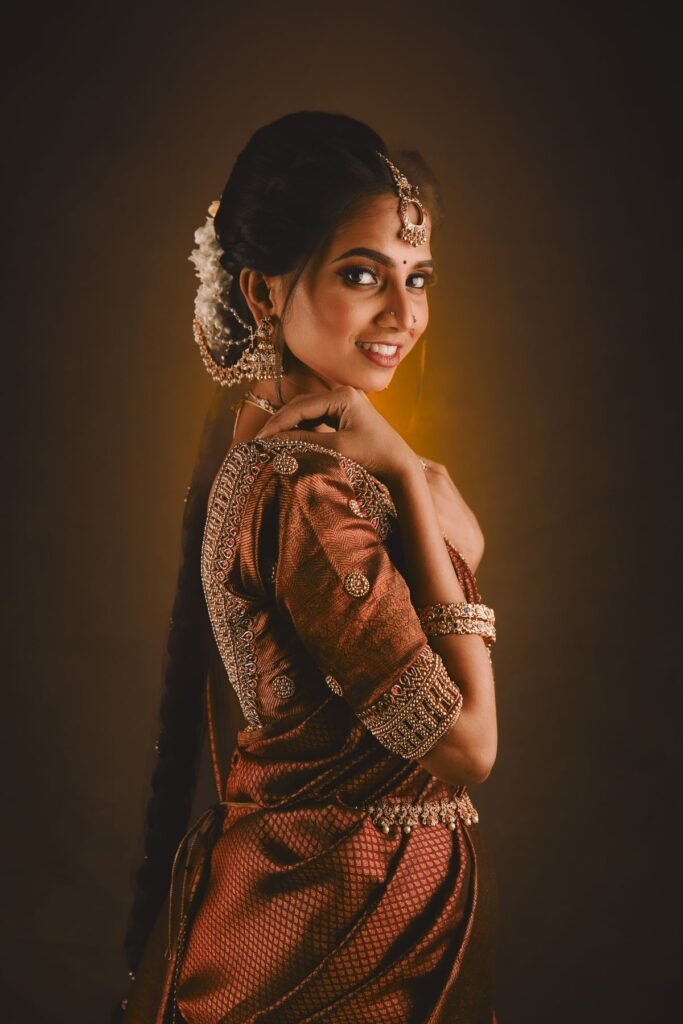
The Kanjivaram (or Kanchipuram) saree is the great wedding silk of South India: heavy mulberry silk with wide, contrasting borders and a richly worked pallu. Its construction is unique, the body, border and pallu are woven separately and then interlocked with a join so strong that the border is said to hold even if the body tears. Temple towers, checks, peacocks and other traditional motifs fill the borders, usually in gold zari against deep, saturated colours. A Kanjivaram feels substantial and formal in the hand, and it is worn for weddings, temple ceremonies and major festivals.
Mysore Silk, Karnataka
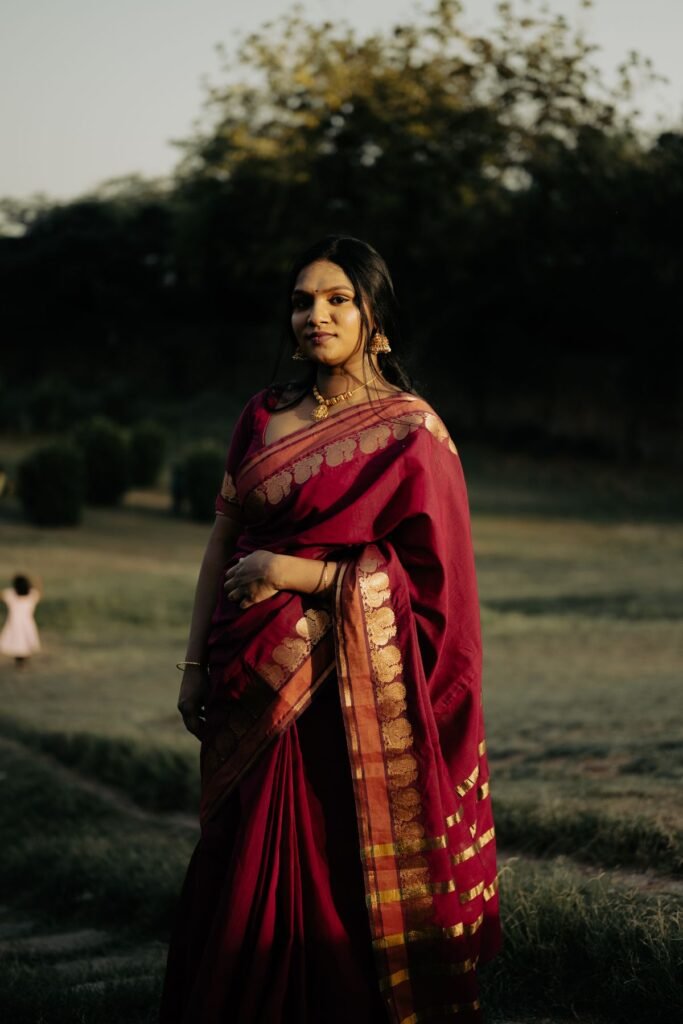
Mysore silk is the minimalist of the family. Woven in Karnataka from pure mulberry silk, the state-owned maker has produced it in Mysore since 1912, it is smooth and light, often in a soft crepe weave, with a plain or near-plain body and a narrow gold zari border. There is no brocade and no heavy patterning; the appeal is the quality of the silk itself and the clean, elegant fall. That restraint makes Mysore silk unusually versatile: formal enough for ceremonies and weddings, easy enough for festive days when a heavy brocade would be too much.
Tussar, Eastern and Central India
Tussar (also spelled tasar) is a wild silk, produced by moths reared outdoors on forest trees across Jharkhand, Chhattisgarh, Odisha, West Bengal and neighbouring states; Bhagalpur in Bihar is its best-known weaving centre. Because the filament is shorter and less even than mulberry, tussar cloth has a dry, slightly slubbed texture and a muted gleam rather than a shine, in natural shades of honey, gold and copper that are often left undyed or paired with block prints and hand painting. A tussar saree feels organic and understated, a favourite for daytime events, cultural occasions and festive wear that does not call for full bridal weight.
Eri, Assam and the North East
Eri, called endi in Assam, is the gentle silk. Its silkworm feeds on castor leaves and, unusually, the cocoon is open at one end, so the moth can leave before the silk is harvested; the broken filament is then spun like cotton or wool. The result is a matte, soft, warm cloth with almost no shine, closer in feel to a fine wool or cotton than to a wedding silk. Eri sarees and shawls are valued in the North East for warmth and comfort, and eri is often chosen by buyers looking for a silk made without killing the moth inside the cocoon.
Muga, Assam
Muga is the golden silk of Assam, produced nowhere else in the world. The silkworm feeds on som and soalu leaves, and the fibre emerges a natural, rich gold that is usually woven undyed, colour would only cover what makes it precious. Muga cloth is dense and strong, with a glow that wearers say deepens with age and washing, and “Muga Silk of Assam” is protected by a Geographical Indication. Traditionally woven into mekhela chadors and sarees for ceremonies and festivals, a muga saree is a connoisseur’s piece: rare, durable and unmistakable.
Patola, Patan, Gujarat
Patola is the masterwork of ikat. In Patan, Gujarat, both the warp and the weft threads are resist-dyed before weaving, double ikat, so that when the cloth is woven, geometric and figurative patterns in saturated reds, greens and yellows emerge with the same clarity on both sides of the fabric. Aligning pre-dyed threads so the pattern lands exactly is extraordinarily demanding, which is why a genuine handwoven Patola is among the most prized of all silk sarees, traditionally worn for weddings and heritage occasions and kept as an heirloom.
Bandhani Silk, the Tie-Dye Tradition
Bandhani (bandhej) is not a weave but a dyeing art: the silk is pinched and tied in thousands of tiny knots before dyeing, and where the ties resist the dye, a field of fine dots and patterns remains. On silk, Bandhani produces sarees of great lightness and movement, frequently finished with woven zari borders, Varanasi even marries the two crafts in the Bandhej Banarasi, where hand-tied patterns meet Banarasi borders. Bandhani silk is festive wear par excellence, long associated with celebrations and weddings in western India.
Rajshahi Silk, Rajshahi, Bangladesh
Bangladesh’s entry on this list comes from Rajshahi, the city on the Padma River in the country’s north-west that is known across Bangladesh simply as the Silk City. Rajshahi produces mulberry silk, its finest variety, alongside eri and tussar, and its sarees are known for a fine, smooth, feather-light cloth with a soft natural sheen, often in deep jewel colours with contrasting borders. Rajshahi silk received Geographical Indication status in Bangladesh in 2021. Less brocaded than a Banarasi and lighter than a Kanjivaram, it is a refined choice for weddings, receptions and formal occasions.
Silk Jamdani, Bangladesh and Uppada
Jamdani is a technique before it is a fabric: motifs are inlaid by hand, thread by thread, into a sheer ground as the cloth is woven, so the patterns appear to float. The classic Jamdani of Dhaka is cotton, but the same technique is woven in silk, as half-silk and pure silk Jamdani in Bangladesh, and as the light silk jamdani of Uppada in Andhra Pradesh, where the motifs are inlaid entirely by hand without jacquard or dobby assistance. A silk Jamdani keeps the airy, floating quality of the cotton original and adds silk’s sheen, making it one of the most elegant of all festive sarees. Our guide to the types of Jamdani sarees explains how the cotton, half-silk and silk versions differ.
A Word on Labels: Art Silk and “Soft Silk”
Two labels deserve a caution. Art silk is artificial silk, usually viscose rayon or polyester, and is not silk at all, however convincing the sheen. Soft silk is a finish or marketing term, not a fibre; it can describe pure silk, a blend, or art silk. If genuine silk matters to you, look for the Silk Mark tag, the certification launched by India’s Central Silk Board in 2004, which guarantees the fibre is 100% natural silk, and ask the seller to state the fibre plainly.
How to Choose Among Them
Start with the occasion. For a wedding, the weight and ceremony of Banarasi and Kanjivaram brocade are the traditional answers, with Patola as the heirloom alternative. For formal wear without the weight, Mysore silk and Rajshahi silk drape lightly and elegantly. For texture and natural tones, choose tussar; for warmth and a matte, understated feel, eri; for something genuinely rare, muga. And for festive colour and movement, Bandhani silk and silk Jamdani are hard to beat. Climate matters too: heavy mulberry brocades are warm, so lighter silks earn their place in summer, a point worth weighing if you are shopping from a warm part of the United States.
Frequently Asked Questions
Q: What are the four types of silk?
India’s four natural silks are mulberry, tussar (tasar), eri and muga. Mulberry comes from the domesticated silkworm fed on mulberry leaves and is smooth and lustrous; tussar is a textured wild silk; eri is a soft, matte spun silk; and muga is the naturally golden silk produced only in Assam. Most named saree types, Banarasi, Kanjivaram, Mysore, are weaving traditions built on mulberry silk.
Q: Which type of silk saree is best for a wedding?
Banarasi and Kanjivaram are the classic wedding choices: both are mulberry silk with rich zari work, Banarasi brocaded with Mughal-inspired florals and Kanjivaram built with wide contrast borders. Patola is the heirloom alternative, and a fine Rajshahi silk or silk Jamdani suits a lighter, more understated wedding look.
Q: What is the difference between Banarasi and Kanjivaram sarees?
Both are heavyweight mulberry wedding silks with zari, but they are built differently. A Banarasi, from Varanasi, covers its body with brocade, florals, paisleys and jaal patterns woven in gold and silver thread. A Kanjivaram, from Kanchipuram in Tamil Nadu, keeps its drama in wide, contrasting borders and pallu that are woven separately and interlocked with the body, often with temple motifs.
Q: Is art silk real silk?
No. Art silk is short for artificial silk, usually viscose rayon, polyester or a blend, made to imitate silk’s sheen at a lower cost. It contains no silk fibre. A Silk Mark tag, by contrast, certifies that a saree is 100% natural silk.
Q: Which is the rarest silk saree?
Muga, from Assam, is generally considered the rarest: its silkworm feeds on som and soalu leaves and is raised only in that region, and the silk’s natural golden colour cannot be replicated elsewhere. Handwoven double-ikat Patola, which can take months of dyeing and weaving for a single saree, is a close rival in rarity.
Conclusion
The different types of silk sarees make sense once you hold the two organising ideas apart: the fibre, mulberry, tussar, eri or muga, and the weaving tradition that shapes it, from Varanasi’s zari brocade and Kanchipuram’s interlocked borders to Patan’s double ikat, Rajshahi’s feather-light mulberry and Dhaka’s floating Jamdani motifs. Each type has a character of its own and an occasion it suits best. Learn to read those two things on any listing, what silk, woven how, and where, and you will know exactly what kind of saree you are looking at.