
 Image credit: Pexels
For five days every autumn, the saree stops being an outfit and becomes a language. During Durga Puja, Bengal’s greatest festival, honoring the goddess Durga’s victory and her annual visit to her parental home, what you wear, and how you drape it, speaks of devotion, celebration, family, and home. A white saree with a red border at the morning anjali says something different from a jewel-toned silk at the Navami evening program, and longtime Puja-goers read those messages fluently.
If you are building your looks for the festival, whether at a Kolkata pandal, a community celebration in New Jersey or Houston, or your first Puja, these saree styling ideas for Durga Puja will carry you from Shashthi to Dashami with traditions intact and comfort sorted.
- The Red-and-White Saree: Bengal’s Puja Signature
- Five Days, Five Moods: Styling Shashthi to Dashami
- The Weaves of Pujo: Tant, Garad, and Jamdani
- The Aatpoure Drape: Where the Look Comes Together
- Jewelry, Hair, and Makeup: The Finishing Touches
- Celebrating Durga Puja in the USA
- Frequently Asked Questions
- Conclusion
The Red-and-White Saree: Bengal’s Puja Signature
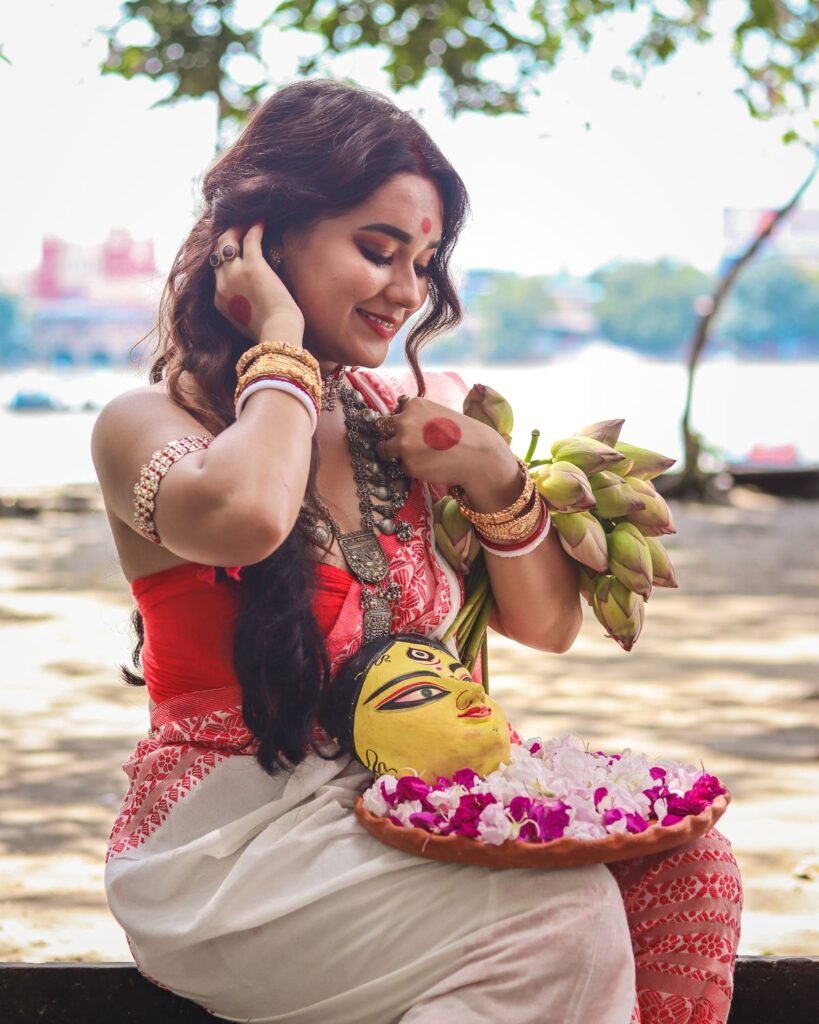
Ask anyone to picture Durga Puja and one image arrives first: a woman in a white or off-white saree with a deep red border, the lal-paar shada saree, a red blouse beneath it, a round red bindi, and gold at her ears and wrists. It is the festival’s signature look, worn above all for the Ashtami morning anjali and the Dashami sindoor khela, and its colors are no accident.
In Bengali tradition, white stands for purity, serenity, and devotion, the clean, unadorned heart brought before the goddess. Red stands for strength, fertility, and shakti, the divine feminine energy that Durga herself embodies; it is also the color of sindoor, the vermilion of married life and blessing. Worn together, the two colors hold the whole theology of the festival in a single drape: the devotee’s purity meeting the goddess’s power. The look is traditionally completed with shakha and pola, white conch-shell and red lac or coral bangles worn by married Bengali women, and, on Dashami, streaks of vermilion that turn the white ground into a record of the day’s joy.
The combination appears in several fabrics: in crisp handloom cotton it is the everyday tant version; in silk it becomes the garad, the most ceremonial form of the look. The choice between them is about the hour, the ritual, and how long you will be on your feet.

Five Days, Five Moods: Styling Shashthi to Dashami
Shashthi, the joyful beginning. On Shashthi the goddess’s face is unveiled and the festival truly begins. The mood is fresh and expectant, and the dressing matches it: bright, cheerful colors, turmeric yellow, leaf green, coral, sky blue, in light cotton or silk-cotton. Shashthi is for the first excited pandal visits of the evening, an easy drape with small jhumkas is the whole look.
Saptami, the day of wandering. Saptami opens with the Nabapatrika ritual, in which nine plants, with a banana plant, the Kola Bou, draped in a saree at their center, are bathed and installed beside the goddess. For devotees it is the great pandal-hopping day: temples and pandals from morning to night, family lunches in between. Breathable handloom cotton is the intelligent choice, in festive colors with a woven border. A kantha-stitch saree, its running-stitch embroidery telling folk stories across the cloth, is a beloved Saptami evening option, beautiful under pandal lights.
Ashtami, the sacred heart of the festival. Ashtami is the most important day, and its morning belongs to the anjali, when devotees offer flowers to the goddess, many fasting until the pushpanjali is done. This is the hour of the red-and-white saree in its full form: garad silk or a fine white tant with a red border, a red blouse, sindoor, shakha-pola, and the Aatpoure drape. In many places Kumari Puja follows, honoring a young girl as the living goddess. Then, at the exact junction of Ashtami and Navami, comes Sandhi Puja, the festival’s most charged ritual moment, marking the instant of Durga’s victory. By evening, the mood lifts into celebration, and richer silks in maroon, deep pink, or royal blue take over for the cultural programs.
Navami, the grand finale. Navami is the last full day, opened with a sacred fire ritual and filled with a bittersweet determination to celebrate to the fullest. This is the evening for your finest saree: a rich Banarasi, a statement Jamdani, a deep jewel-toned silk with gold jewelry worn generously. The Navami night, aarti, the swirling dhunuchi dance with its earthen incense burners, music, and adda that runs late, is Puja’s glamorous peak, and it rewards dressing like it.
Dashami, the farewell. On Vijaya Dashami, women gather to bid the goddess goodbye in the ritual of Devi Boron: offering her sweets, touching her feet, and applying sindoor to her forehead, and then, turning to each other, to their own. That joyful exchange becomes sindoor khela, when married women smear vermilion on one another’s faces and sarees amid laughter and dhaak drums, before the idol is carried to the water for immersion. Wear the red-and-white once more, but choose a cotton tant this time: vermilion will find your saree, and that is entirely the point. After the farewell comes Bijoya, visiting elders, exchanging sweets, and pronam, and a softer, simpler drape for the evening’s rounds.
| Day | The Mood | Saree Direction | Styling Notes |
|---|---|---|---|
| Shashthi | Fresh beginnings | Light cotton or silk-cotton in bright colors | Easy drape, small jhumkas, evening pandal visits |
| Saptami | Wandering and wonder | Breathable handloom cotton; kantha stitch for evening | Comfort first, a full day on your feet |
| Ashtami | Sacred and iconic | Red-and-white garad or tant for anjali; rich silk at night | Aatpoure drape, sindoor, shakha-pola, red bindi |
| Navami | The grand celebration | Your finest silk or Jamdani in jewel tones | Full gold jewelry, evening aarti and programs |
| Dashami | Farewell and vermilion | Red-and-white cotton tant for sindoor khela | Choose a saree that can carry sindoor stains proudly |
The Weaves of Pujo: Tant, Garad, and Jamdani
Tant is Bengal’s handloom cotton, crisp, light, and breathable, woven in centers such as Shantipur, Phulia, and Dhaniakhali in West Bengal and Tangail in Bangladesh. It is the workhorse of the festival: affordable in spirit, endlessly varied in border and motif, and kind through long, warm days of walking and queuing. A good tant holds its pleats and softens with love and washing.
Garad is the silk counterpart, an off-white silk woven in the Murshidabad tradition, with a red border and a mostly unadorned body, sometimes touched with small woven motifs. Its restraint is its ceremony: garad is the saree of the Ashtami anjali, of ritual purity, of the festival’s most photographed hour. If you own one heirloom Puja saree, this is the form it most likely takes.
Jamdani is the treasure. Woven by hand on the loom, its motifs, flowers, vines, paisleys, are inlaid thread by thread into a fine, feather-light ground, so the patterns seem to float on air. If you are new to the weave, our introduction to what a Jamdani saree is explains how it is made and why it is treasured. In white and red it offers a luminous take on the classic look; in deep colors it is the natural choice for a Navami evening. Cotton Jamdani keeps the festival’s daytime comfort; half-silk versions add a gentle sheen for after dark.
The Aatpoure Drape: Where the Look Comes Together
The saree is only half the signature, the drape completes it. The traditional Bengali Aatpoure style wraps the saree with wide box pleats at the front and brings the pallu around over both shoulders, framing the torso and displaying the border on both sides. Generations ago, the mistress of the house would tie her bunch of keys to the pallu’s end; today the gesture survives as the drape’s unmistakable silhouette. Aatpoure instantly reads as Bengali, keeps the pallu secure without constant adjustment, a blessing during anjali, and shows a red border to its fullest advantage.
If you would like to see how Aatpoure sits among the subcontinent’s great regional styles, our survey of traditional Indian saree draping styles places it alongside the Nivi, the Gujarati seedha pallu, and the nine-yard drapes of Maharashtra and Tamil Nadu. The classic Nivi drape serves beautifully the rest of the festival, Aatpoure is the one to learn for Ashtami morning and Dashami.
Jewelry, Hair, and Makeup: The Finishing Touches
Puja jewelry speaks gold. The classic Bengali arrangement pairs a longer necklace, the sita haar, with a closer choker, jhumka or kana-bala earrings, and bangles stacked with the shakha-pola. For daytime cottons, scale it down: one necklace or a pair of statement earrings is plenty, and oxidized silver gives an artistic ease. The red bindi is near-universal, round, centered, and unapologetic, and kajal-lined eyes carry the festive face from morning anjali to evening program with only a lipstick refresh in between.
Hair traditionally gathers into a low bun, sometimes dressed with fresh flowers, shiuli, the night jasmine that scents Puja mornings, is the poetic choice, though loose waves are now just as common for evenings. On Dashami, many women dust alta, the red dye, along their feet for the farewell rituals. Keep the whole picture durable, makeup that survives long days of crowds, incense, and embraces beats makeup that merely starts well.
Celebrating Durga Puja in the USA
Across the United States, Bengali associations and temples host community pujas that recreate the festival’s heart in school halls, community centers, and temple grounds, often concentrated on the nearest weekend so working families can attend. The rhythm will feel familiar: anjali in the morning, bhog served to long happy lines at midday, cultural programs and adda into the evening. And the sarees come out in full force, red-and-white classics beside Dhaka Jamdanis beside wedding silks, because for the diaspora, dressing for Puja carries Kolkata, Dhaka, and childhood autumns into an American October.
A few practical notes for US celebrations. Fall weather asks for a layer you can drape over your saree between the parking lot and the hall. Events often run day into night in a single venue, so choose a saree, a Jamdani or silk-cotton is ideal, that can be dressed simply for anjali and lifted for the evening with a blouse change or added jewelry. And if you are a guest joining Bengali friends for the first time: wear your saree with confidence, accept the bhog, and do not be surprised when the Dashami vermilion finds you too. It is considered a blessing.
Frequently Asked Questions
Q: What is the traditional saree to wear for Durga Puja?
The classic choice is a white or off-white saree with a red border, garad silk for the most ceremonial moments, tant cotton for everyday wear, paired with a red blouse and draped in the Bengali Aatpoure style. Across the five days, women also wear handloom cottons, kantha-stitch sarees, Jamdani, and rich silks, saving their finest pieces for Ashtami and Navami evenings.
Q: Why do women wear red and white sarees during Durga Puja?
The colors carry the festival’s meaning. White symbolizes purity, serenity, and devotion, while red symbolizes strength, fertility, and shakti, the divine feminine power that Goddess Durga embodies, and the color of sindoor, the vermilion of blessing. Wearing the two together is both an offering of devotion and an identification with the goddess herself.
Q: Which saree is best for the Ashtami anjali?
A red-and-white garad silk or a fine white tant with a red border is the traditional and most fitting choice. You will stand for the flower offering, often after fasting, so favor a saree that drapes securely, the Aatpoure style helps, with a comfortable blouse and restrained jewelry. Save the heavy silks and full jewelry for the Ashtami evening programs.
Q: What should I wear for sindoor khela on Dashami?
Wear the red-and-white combination in a cotton tant rather than silk. Sindoor khela involves smearing vermilion on one another, and your saree will inevitably share in the celebration, most women embrace this and keep a dedicated saree for the ritual. Add a red blouse, shakha-pola bangles, and a generous spirit; the stains are part of the memory.
Q: How is Durga Puja celebrated with sarees in the USA?
Bengali associations and temples across the US host community pujas, often on the weekend closest to the festival, with morning anjali, midday bhog, and evening cultural programs. Women wear the full traditional range, red-and-white tant and garad, Jamdani, and festive silks, often choosing versatile sarees that can move from daytime rituals to evening events, with a warm layer for autumn weather.

Conclusion
Durga Puja dressing is a five-day conversation between devotion and delight: the freshness of Shashthi, the wandering of Saptami, the sacred red-and-white of Ashtami, the splendor of Navami, and the vermilion farewell of Dashami. Choose the weaves Bengal loves, tant, garad, and Jamdani, learn the Aatpoure drape for the festival’s great mornings, and let gold, a red bindi, and a glad heart finish every look. Wherever you celebrate, Kolkata or California, the saree will say what words cannot: the goddess has come home, and so have you.