
 Image credit: Pexels
Of all the choices that shape a saree outfit, the sleeve is the one people notice last and feel first. A full sleeve changes the whole character of a drape: it looks composed, formal and finished in a way no short sleeve quite matches, and it quietly solves practical problems too, cold venues, dress codes, arms you would rather keep covered. Yet full sleeve saree blouse designs are often treated as a winter-only, wedding-only option, which undersells them. Cut well, a full sleeve choli works across silk, chiffon and cotton sarees, from a January wedding in Chicago to an office celebration in Houston. This guide walks through the main design families, the cuff and border finishes that make a sleeve look intentional, the sarees and occasions they suit best, their honest limits, and the tailoring notes that keep a wrist-length sleeve comfortable all day.
- What Counts as a Full Sleeve Blouse?
- The Main Design Families
- Cuffs, Borders and Finishing Details
- Which Sarees Pair Best With Full Sleeves
- The Best Occasions for Full Sleeve Blouses
- The Honest Limits: Heat and Movement
- Tailoring Notes: A Full Sleeve That Moves With You
- Frequently Asked Questions
- Conclusion
What Counts as a Full Sleeve Blouse?
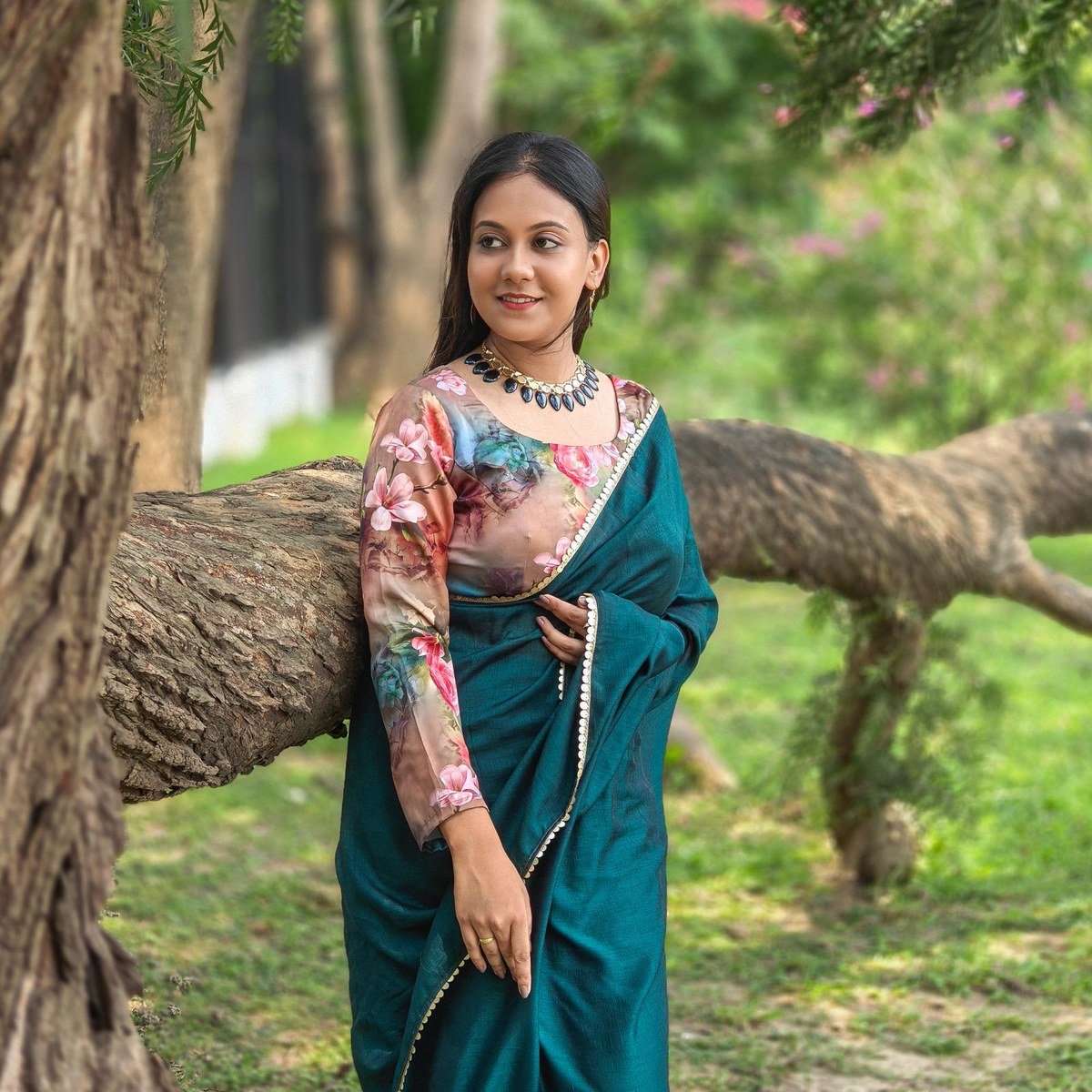
A full sleeve runs from the shoulder point all the way to the wrist bone, roughly 21 to 24 inches on most adults, though your own arm is the only measurement that matters. Within that length there are two classic cuts. The straight fitted sleeve follows the arm closely and ends plainly at the wrist or with a small cuff. The churidar or bangle sleeve is cut longer than the arm and deliberately snug, so the extra fabric settles into fine gathers at the wrist, like the folds of a churidar pajama; it is a traditional favorite with silk sarees because the soft ruching looks rich without any added work. Three-quarter sleeves, stopping a hand’s width above the wrist, are close cousins and a good compromise, but this guide is about the true wrist-length sleeve.
The Main Design Families
Fitted silk sleeves. The classic: a plain, close-fitting sleeve in silk, raw silk or brocade, usually stitched from the saree’s own blouse piece or a matching silk. It is the natural partner for Banarasi, Kanjivaram and other woven silks, with the saree’s border often repeated as a band at the wrist. Understated and formal, this is the version that never looks dated.
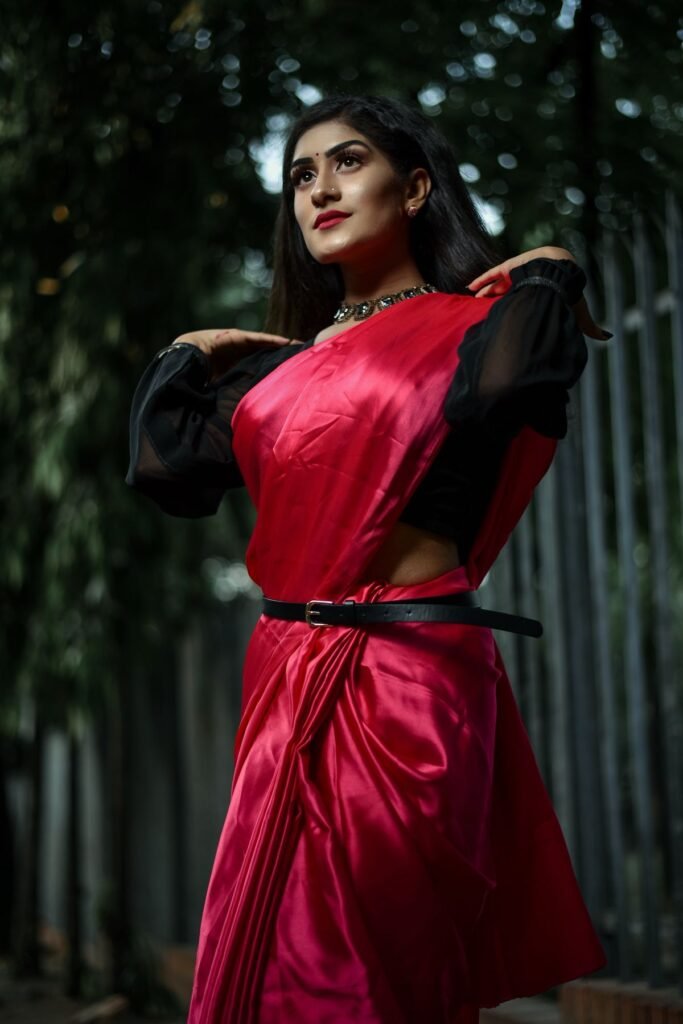
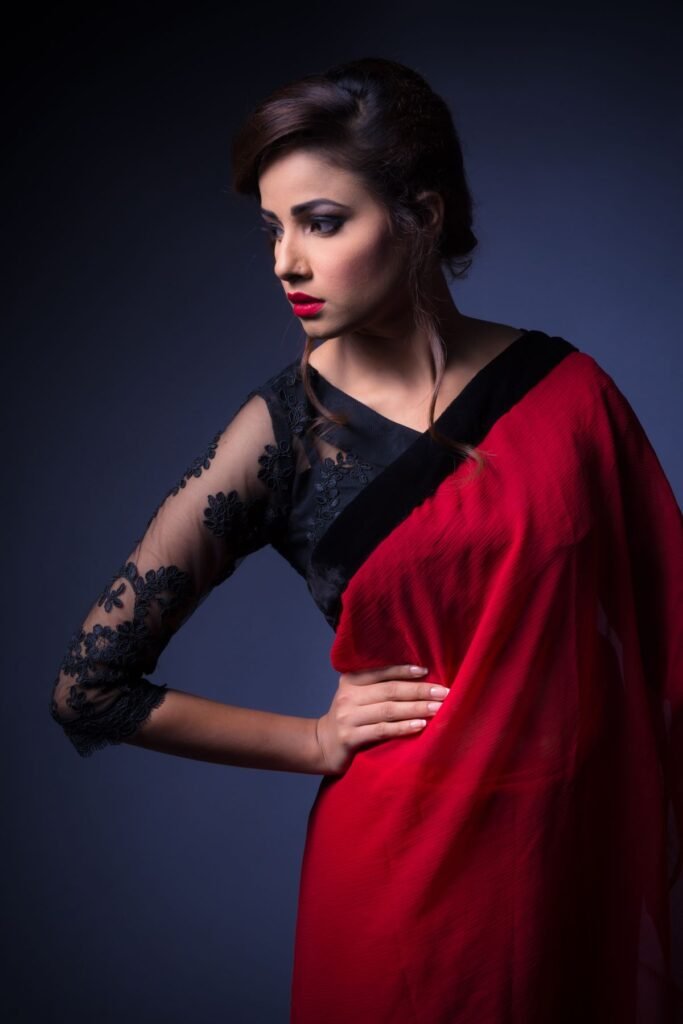
Sheer and lace-effect sleeves. Here the blouse body is lined and opaque, but the sleeves are net, organza, chiffon or lace, plain or scattered with small motifs. Sheer full sleeves give you coverage without visual weight, which is why they are a party and evening favorite: the arm is covered, yet the look stays light, and bangles show softly through the fabric. They are also the coolest full sleeve to wear, which extends the style well beyond winter.
Embroidered and mirror-work sleeves. When the sleeve itself is the decoration, thread embroidery running down the arm, zardozi cuffs, mirror work or sequins on net or silk, the blouse becomes the statement piece of the outfit. These belong with plain or lightly woven sarees, where the sleeve has room to be seen; pairing heavy embroidered sleeves with a heavily worked saree usually results in both competing. Because the pallu covers one shoulder and part of one arm, many wearers keep the embroidery concentrated from elbow to wrist, where it stays visible.
Velvet sleeves and velvet blouses. Velvet is the winter luxury option: a full velvet blouse, or a silk blouse with velvet sleeves, reads deep and formal in jewel tones and needs almost no embellishment. It pairs beautifully with plain silk and satin-finish sarees at evening events. Velvet has no give and holds heat, so it is a cold-weather, air-conditioned-ballroom fabric, plan it for the season, not against it.
Shaped sleeves: bishop, balloon and bell. Not every full sleeve is fitted. A bishop or balloon sleeve is full along the arm and gathered into a cuff at the wrist, giving soft volume; a bell sleeve is fitted to the elbow and flares from there. These need fluid fabrics, chiffon, crepe, soft georgette, and plain sarees, and bring a festive, dramatic note a straight sleeve does not.
If you want the wider picture of where sleeves sit among current neckline, back and fabric trends, our overview of the latest saree blouse designs covers the full landscape; the rest of this guide stays with the wrist-length sleeve.
Cuffs, Borders and Finishing Details
On a fitted sleeve, the last two inches do most of the design work. A border band, the saree’s own border fabric or zari strip applied at the wrist, ties the blouse to the saree and is the traditional finish on silk blouses. A buttoned or hooked cuff, shirt-style, reads tailored and modern, and suits office wear especially well with a collar or high neck. Embroidery placed only at the cuff is the economical version of the embroidered sleeve: the detail sits where hands and bangles draw the eye, while the upper sleeve stays plain. Two practical points hide in the finishing. First, a snug wrist needs an opening, a small slit with hooks or buttons, or your hand will not pass through. Second, whatever sits at the wrist will rub against bangles, watch straps and table edges all day, so delicate raised work belongs slightly above the wrist bone, not on it.
Which Sarees Pair Best With Full Sleeves
| Saree | Full sleeve choice | Why it works |
|---|---|---|
| Banarasi and Kanjivaram silk | Fitted silk sleeve with a border band at the wrist | Matches the saree’s formality; the woven border repeated at the cuff looks intentional |
| Rajshahi and other soft silks | Plain fitted sleeve, or sheer sleeve for evening | Keeps the focus on the silk’s sheen while adding polish |
| Plain chiffon or georgette | Embroidered, mirror-work or bishop sleeve | The sleeve supplies the detail the saree leaves out |
| Net and embellished party sarees | Sheer full sleeve with scattered motifs | Coverage that stays light and lets the saree’s work show |
| Handloom cotton and Jamdani | Simple fitted cotton or silk-cotton sleeve | Honors the handloom character; heavy work would overwhelm the weave |
| Plain saree for winter evenings | Velvet blouse or velvet sleeves | Warmth and depth of color in one decision |
The general rule is a balance of weight: the richer the saree, the plainer the sleeve, and vice versa. Silk sarees in particular reward restraint, if you are choosing among the major weaves, our guide to the different types of silk sarees explains how each one’s surface and border behave, which is exactly what decides the sleeve finish.
The Best Occasions for Full Sleeve Blouses
Winter weddings in the US. This is the full sleeve’s home ground. A December or January wedding, ceremony in a hotel ballroom, photographs outside, a venue door opening to cold air all evening, is genuinely uncomfortable in a sleeveless blouse, and a shawl hides the saree you chose so carefully. A fitted silk or velvet full sleeve keeps the outfit complete and visible while taking the edge off the cold between spaces.
Formal and religious settings. Full sleeves read formal in a way short sleeves do not, and they meet the covered-arms expectation of many temples, mosques and conservative family ceremonies without any last-minute layering. At weddings, where you greet elders and take part in rituals, that composure is worth planning for.
Office and professional events. A cuffed full sleeve with a high or boat neck is the most workplace-appropriate blouse silhouette there is, it sits naturally alongside blazers and shirting at office Diwali parties, cultural heritage events and conferences where you are representing both your culture and your employer.
Modest styling, by preference. Many women simply prefer their arms covered, at every age and for every reason from comfort to sun protection. A sheer full sleeve is the version worth knowing here: full coverage, minimal warmth, nothing matronly about it.
The Honest Limits: Heat and Movement
Full sleeves are not the right answer everywhere, and two limits are real. The first is heat. A fitted sleeve in silk, brocade or velvet at an outdoor summer event in Texas, Florida or Arizona will be warm in a way no design trick fixes; sheer net or chiffon sleeves are the only full sleeves that stay reasonable in heat, and even they are a compromise compared with an elbow sleeve. The second is movement. A wrist-length sleeve involves more fabric around the elbow and forearm than any other cut, so a badly fitted one pulls when you lift your arms, reach across a table or pin your pallu. That is a tailoring problem rather than a flaw in the style, but it means a full sleeve blouse is not the design to order untested the week before an event. Finally, a practical note: long sleeves meet food, hand-washing and toddlers, and light colors show every splash at the cuff, for hands-on family functions, a darker or three-quarter sleeve is often the calmer choice.
Tailoring Notes: A Full Sleeve That Moves With You
- Measure the arm bent, not hanging. Sleeve length and the elbow round should be taken with the elbow flexed, or the sleeve will bite at the inner elbow every time you bend your arm.
- Ask for ease where it matters. A fitted sleeve in a non-stretch fabric needs roughly half an inch to an inch of ease over the bicep, and room at the elbow. Silk, brocade, tissue and velvet have no stretch to forgive a tight cut.
- Mind the armhole. A closer, slightly higher armhole lets you raise your arm without the whole blouse lifting; a low, loose armhole is the most common cause of the “can’t lift my arms” complaint.
- Consider a moderate sleeve cap. A very high sleeve cap looks sharp but restricts reach. For an all-day event blouse, a moderate cap drapes better and moves better.
- Plan the wrist opening. If the cuff is snug, specify a slit with hooks or buttons, and check at the fitting that your hand passes through comfortably.
- Do the movement test at the trial fitting. Lift both arms to shoulder height, cross them in a self-hug, bend the elbows fully, and reach over one shoulder as if pinning your pallu. Adjust before the blouse is finished, not after.
- Keep seam allowance. Ask for extra margin in the side and sleeve seams so the blouse can be let out later, sleeves are where weight changes show first.
Frequently Asked Questions
Q: What is a full sleeve saree blouse?
It is a saree blouse whose sleeves run from the shoulder all the way to the wrist bone, typically about 21 to 24 inches long. It comes in two classic cuts, a straight fitted sleeve and the snug churidar or bangle sleeve, whose extra length settles into soft gathers at the wrist, plus sheer, embroidered, velvet and shaped versions such as bishop and bell sleeves.
Q: Which sarees look best with full sleeve blouses?
Silk sarees are the classic pairing: a fitted silk sleeve with a border band at the wrist suits Banarasi and Kanjivaram weaves. Plain chiffon and georgette sarees pair well with embroidered, mirror-work or bishop sleeves, which supply the detail the saree lacks. Sheer full sleeves suit net and party sarees, and a simple fitted sleeve in cotton or silk-cotton respects the character of handloom cotton and Jamdani.
Q: Are full sleeve blouses comfortable in summer?
Only in the sheer versions. A full sleeve in net, organza or chiffon adds coverage without much warmth and is wearable on summer evenings. A fitted sleeve in silk, brocade or velvet is a cold-weather choice, at an outdoor summer event it will feel hot, and an elbow or three-quarter sleeve is the more comfortable way to keep some coverage.
Q: Can you move freely in a full sleeve blouse?
Yes, if it is tailored for movement. The usual causes of restriction are a low, loose armhole, a sleeve measured with the arm hanging straight, and no ease at the bicep and elbow. Ask for a closer armhole, a moderate sleeve cap, measurements taken with the elbow bent, and test the blouse at the fitting by lifting your arms, bending your elbows and reaching over your shoulder.
Q: Which fabrics work best for full sleeve blouses?
Silk and raw silk for the classic fitted sleeve with formal sarees; brocade when you want woven richness; net, organza and lace for sheer sleeves; velvet for winter evenings; and chiffon or crepe for shaped bishop and bell sleeves that need to drape. Cotton and silk-cotton make the most comfortable everyday full sleeves with handloom sarees.

Conclusion
Full sleeve saree blouse designs deserve better than their winter-wedding stereotype. In fitted silk they complete a Banarasi; in sheer net they cover the arm without covering the look; in velvet they carry a plain saree through a cold evening; and with an embroidered cuff they can be the single detail an outfit is remembered by. The style asks two things in return: honesty about the weather, and a tailor brief that protects your movement, bent-elbow measurements, ease at the bicep, a closer armhole and a real movement test at the fitting. Give it those, and the full sleeve stops being the cautious option and becomes what it looks like: the most finished one.