
 Image credit: Pexels
Two sarees can hang side by side in the same shop, woven from the same fiber in similar colors, and one costs several times more than the other. Very often the difference is not the silk or the cotton, it is the loom. One was woven by a person, thread by thread, on a handloom. The other rolled off a powerloom, a machine that does the same basic job at industrial speed. Understanding the handloom vs powerloom saree difference helps you judge whether a price is fair, know what you are actually paying for, and choose the saree that fits how you live. This guide compares the two across every factor that matters: how each is made, speed, uniformity, feel, durability, design, price character, and impact, then shows you how to tell them apart before you buy.
- What the Two Terms Actually Mean
- How Each Saree Is Made
- Speed and Volume: Days Versus Minutes
- Uniformity vs. the Human Touch
- Feel, Drape and Durability
- Design Capability
- Price Character: What the Gap Pays For
- Environment and Livelihoods
- Handloom vs Powerloom Saree at a Glance
- How to Tell Them Apart When Buying
- Which Should You Choose? A Scenario Guide
- Frequently Asked Questions
- Conclusion
What the Two Terms Actually Mean
Handloom describes a method, not a fiber or a region. A handloom is a loom powered entirely by the weaver’s body, hands throwing the shuttle, feet working the treadles that lift the warp threads. Pit looms, frame looms and jacquard handlooms (which use punched cards to control pattern threads) are all handlooms as long as human muscle and judgment drive every pick of weft. A handloom saree can be cotton, silk, linen or a blend.
Powerloom describes the same weaving idea mechanized. A motor drives the shedding, picking and beating-up motions, so the loom runs continuously at high speed with an operator supervising rather than weaving.
One clarification matters for shoppers: “handloom” says nothing by itself about quality or authenticity of design. A handloom saree can be plain and coarse; a powerloom saree can be finely woven. What the loom changes is the process, and the process leaves fingerprints you can learn to read.
How Each Saree Is Made
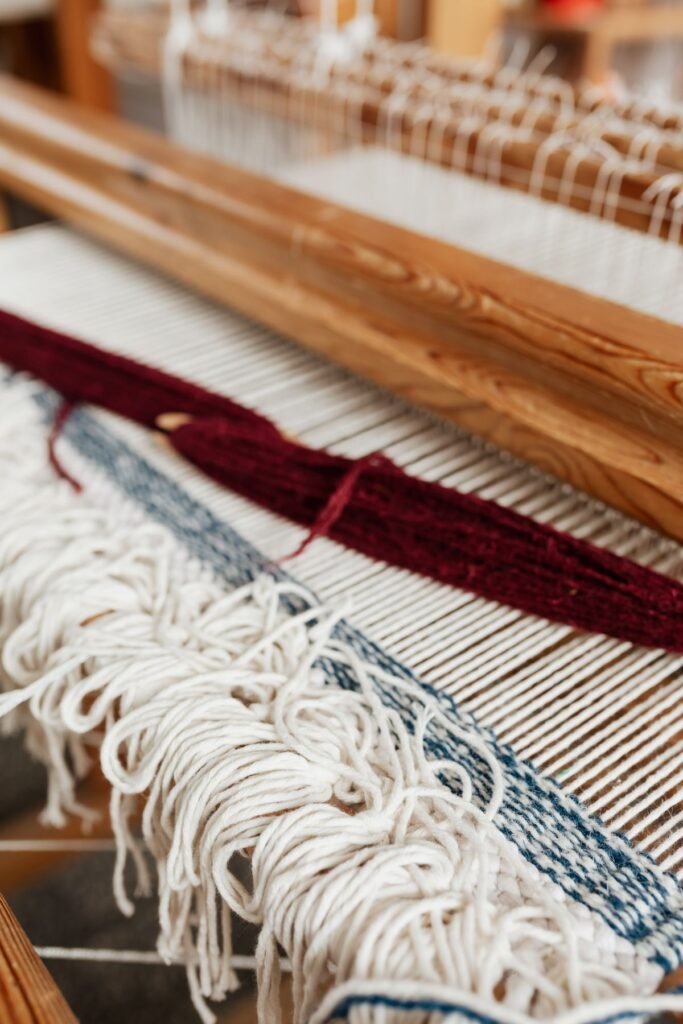
On a handloom, weaving is a sequence of decisions. The weaver sets up thousands of warp threads, then works rhythmically, treadles lift selected warps, the shuttle carries the weft across, and the reed beats it into place. Patterned sarees demand more: in extra-weft techniques, the weaver inserts motif threads by hand, sometimes with small bobbins, exactly where each motif belongs. Bengal’s Jamdani is a celebrated example, its motifs are built with a discontinuous weft, pick by pick, as our guide to what a Jamdani saree is explains. Setup alone can take days, and a complex saree can occupy the loom for weeks.
On a powerloom, the same interlacing happens mechanically. Once the machine is threaded and the pattern is set, by cam, dobby or electronic jacquard, it repeats the design at a steady, rapid pace, and the operator’s role is to feed yarn, watch for breakages and change beams.
Speed and Volume: Days Versus Minutes
The production gap is enormous. A skilled weaver produces a limited length of cloth per day, and an intricately patterned handloom saree may take anywhere from several days to several weeks of loom time. A powerloom produces comparable yardage in a small fraction of that time and can run near-continuously across shifts, turning out saree after identical saree.
This is why the two products live in different worlds commercially. Handloom production suits small batches, custom orders and one-off designs; powerloom production suits volume, where the economics improve with every additional identical piece. Neither fact is a moral judgment, but it explains almost everything else in this comparison, from price to uniformity.
Uniformity vs. the Human Touch
A powerloom’s great strength is consistency. Tension, spacing and pattern repeats are mechanically controlled, so every motif matches the next and every saree in the run matches the last. The fabric is even, the edges are straight, and what you see in the product photo is precisely what arrives.
A handloom carries the weaver in it. Because a person controls tension and placement, you will find minute variations: a motif a fraction off-grid, a barely perceptible change in thread spacing, small knots where a yarn was joined, slight unevenness along the selvage. Weavers and handloom advocates are firm on this point, these are not defects but evidence of handwork, the textile equivalent of brushstrokes. Buyers should still distinguish charming irregularity from genuine flaws like broken threads or stains; the first is character, the second is a quality problem on any loom.
Feel, Drape and Durability
Handloom fabrics are often described as having a “living” texture. Hand-controlled tension tends to produce cloth with a slightly softer, more breathable hand-feel, and many wearers find handloom cotton and silk drape with a natural fluidity that improves with washing and wear. Traditional handloom sarees are also built to last: woven at moderate speeds with yarns chosen for the loom, a well-made piece can serve for decades and is frequently handed down.
Powerloom fabrics feel more uniform, smooth, even, sometimes slightly stiffer or more “finished” to the touch, depending on the yarns and processing used. Durability varies widely with yarn quality: a powerloom saree in good yarn can wear perfectly well for years, while a cheaply made one in weak yarn will thin and fade quickly regardless of loom type. The honest summary is that the loom influences texture and character strongly, but long life depends on yarn quality and care at least as much.
Design Capability
It is tempting to assume machines can do more. In pattern complexity, modern electronic jacquard powerlooms are genuinely capable, and they reproduce intricate designs with perfect fidelity, run after run. Where the handloom still leads is flexibility and woven-in craftsmanship: a weaver can change a motif mid-saree, blend colors in the weft by hand, and execute techniques, like individually placed extra-weft motifs with no floats on the reverse, that are defined by manual control. Handloom design is artisanal and variable; powerloom design is engineered and repeatable. For a buyer, the practical difference is uniqueness: no two handloom sarees are perfectly identical, while powerloom sarees are identical by intention.
Price Character: What the Gap Pays For
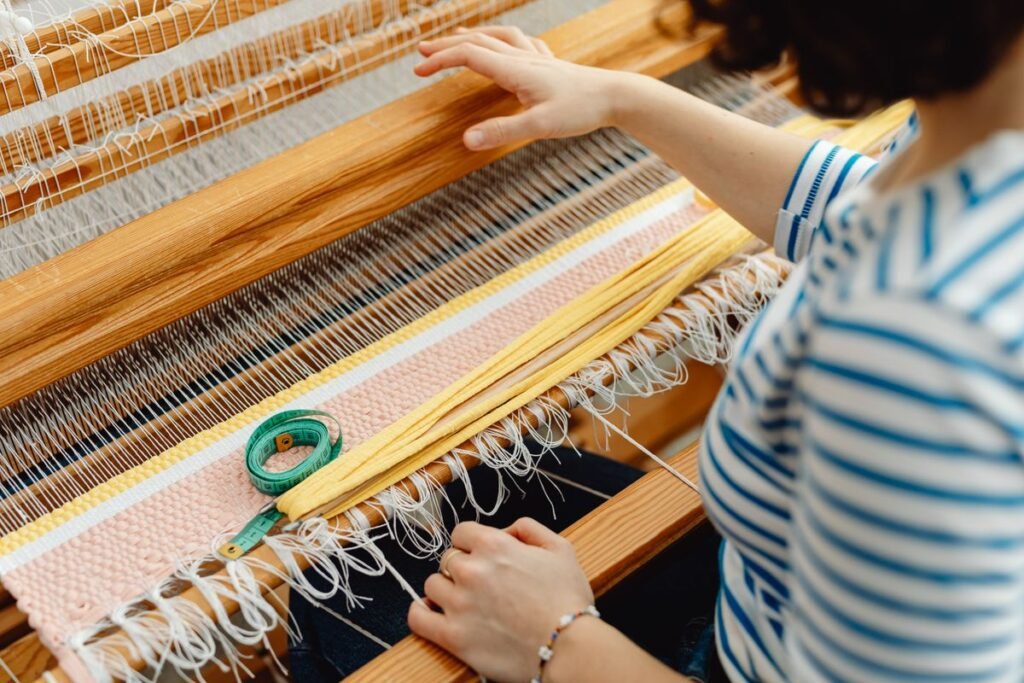
Handloom sarees cost more because time is their main ingredient. Weeks of a skilled weaver’s labor, small-batch setup, and slower production are all priced into a single saree, and that labor is the product as much as the cloth is. Powerloom sarees cost less because machine speed spreads setup costs across thousands of pieces and replaces most of the per-saree labor with electricity and supervision.
Two cautions keep this honest. First, a high price does not prove handloom origin, powerloom imitations are sometimes sold at handloom prices, which is exactly why the identification checks below matter. Second, a modest price does not make a saree a bad purchase: a fairly priced powerloom saree, honestly labeled, can be the right buy for everyday wear. As WeaverStory’s own comparison notes, the handloom vs powerloom distinction is fundamentally about production method, not a simple ranking of worth, see their overview of handloom vs power loom for a weaver’s perspective.
Environment and Livelihoods
The handloom runs on human energy, so its direct energy footprint per saree is minimal, and it anchors livelihoods in weaving communities where skills pass between generations. Buying genuine handloom supports those artisan households, though buyers should remember that weaver earnings depend on fair supply chains, not the label alone.
Powerlooms use electricity and produce at a scale that lowers the cost of clothing accessibly, but volume production is also tied to faster fashion cycles and more textile waste. The balanced view: handloom is the lower-impact, livelihood-supporting choice per piece; powerloom is the affordability and availability choice. Your priorities decide the weight of each.
Handloom vs Powerloom Saree at a Glance
| Feature | Handloom Saree | Powerloom Saree |
|---|---|---|
| Power source | The weaver’s hands and feet | Electric motor, operator-supervised |
| Production speed | Days to weeks per patterned saree | High volume; identical pieces in long runs |
| Uniformity | Minute human variations; no two exactly alike | Mechanically perfect repeats |
| Reverse side | Floats, small knots, hand-finished motif backs | Neat, flat, uniform; motifs mirror cleanly |
| Selvage | Slightly uneven, woven-in edge | Straight, uniform, sometimes heat-sealed or overlocked |
| Feel | Soft, textured, breathes; improves with wear | Smooth and even; can feel stiffer or more processed |
| Design | Flexible, artisanal; hand-placed motifs possible | Engineered, repeatable; complex jacquard possible |
| Price character | Premium, pays for skilled time | Economical, pays for machine efficiency |
| Best role | Heritage pieces, gifts, occasions, collecting | Everyday wear, uniforms, budget dressing |
How to Tell Them Apart When Buying
No single clue is proof, so combine several, the same discipline used to check any heritage weave, as in our guide on how to identify an original Banarasi saree:
- Turn it over. Handloom motif backs show floats, tiny knots and hand-finished irregularity. Powerloom backs look flat, sealed and mechanically tidy.
- Compare the motifs. Hold two repeats side by side. Near-identical but not perfectly identical suggests a hand; pixel-perfect sameness across the whole saree suggests a machine.
- Check the selvage. A handloom edge varies subtly in width and texture along its length. A powerloom edge is ruler-straight, sometimes heat-sealed or overlocked.
- Look for pinholes. Traditional handloom sarees may carry tiny pinhole marks along the edges from being pinned during weaving, a classic handloom sign powerloom fabric lacks.
- Feel the cloth. Handloom fabric usually feels softer and more alive in the hand; heavily uniform, stiff or plasticky fabric deserves questions.
- Ask for the mark. In India, the government-backed Handloom Mark certifies genuine handloom production; GI tags certify regional origin where applicable. Ask the seller directly and judge the confidence of the answer.
- Sanity-check the price. Weeks of skilled handwork cannot retail at throwaway prices. A “handloom” saree priced like a mass-market machine piece almost certainly is one.
Which Should You Choose? A Scenario Guide
- A wedding or heirloom purchase: handloom, the craft, uniqueness and longevity justify the premium.
- Daily office or college wear on a budget: a honestly labeled powerloom or simple handloom cotton, comfort and price matter more than provenance.
- A gift with a story: handloom, ideally with the weaver or region identified.
- Matching outfits for a group or event: powerloom, identical pieces are its specialty.
- Supporting artisan livelihoods: certified handloom from a transparent seller.
- Your first saree: either, choose by fiber and feel, and let the loom be a secondary lesson.
Frequently Asked Questions
Q: What is the main difference between a handloom and a powerloom saree?
The loom that wove it. A handloom is powered and controlled entirely by a weaver’s hands and feet, producing cloth slowly with slight human variation. A powerloom is motor-driven, producing uniform fabric at high speed and volume. The fiber can be identical, cotton or silk in both cases, so the difference is the production method and everything that follows from it: time, texture, uniqueness and price.
Q: How can you tell a handloom saree from a powerloom saree?
Combine several checks: a handloom reverse shows floats and small knots behind motifs, its repeats vary almost imperceptibly, its selvage is slightly uneven, and traditional pieces may show pinholes along the edge. A powerloom saree is uniformly perfect, with a flat, tidy reverse and straight, sometimes sealed edges. Certification such as India’s Handloom Mark, and a seller who answers questions directly, complete the picture.
Q: Why do handloom sarees cost more than powerloom sarees?
Because you are paying for time and skill. A patterned handloom saree can take days to weeks of a trained weaver’s labor, plus days of loom setup, and it is made one piece at a time. A powerloom spreads its setup across thousands of identical sarees and substitutes machine speed for most of the labor, so its per-piece cost is far lower.
Q: Are powerloom sarees bad quality?
Not inherently. A powerloom saree woven from good yarn can be even, durable and entirely fit for everyday wear. Quality problems come from poor yarn and poor finishing, which occur on both loom types. The real issue is honesty: a powerloom saree sold and priced as handloom is a bad purchase, while one sold as itself, at a fair price, can be a sensible buy.
Q: What is the Handloom Mark and why does it matter?
The Handloom Mark is a Government of India certification identifying products genuinely woven on handlooms, created to protect weavers and buyers against machine-made goods sold as handwoven. When a saree carries the mark, or a relevant GI tag for its region, you have verifiable evidence of how and where it was made, rather than a seller’s word alone.

Conclusion
The handloom vs powerloom saree question is not really hand versus machine, it is time versus speed, uniqueness versus uniformity, artisan livelihood versus affordable volume. A handloom saree carries a weaver’s weeks, judgment and small human irregularities in every motif; a powerloom saree carries engineering consistency at a price more people can reach. Learn to read the reverse side, the selvage and the repeats, ask for certification, and let the price make sense against the process. Then choose with open eyes: handloom when the craft is the point, powerloom when practicality is, and either way, a saree whose story matches its label.