
 Image credit: Pexels
If you have ever read a saree description that says “handloom” and wondered what that actually promises, you are not alone. The word appears on everything from simple cotton daily-wear sarees to silk masterpieces that took months to weave. So what is a handloom saree? In short, it is a saree woven on a loom powered entirely by a human being, hands and feet, no electric motor, with the weaver controlling every single row of the cloth. This guide explains what a handloom is, how handloom weaving works step by step, what makes a saree qualify as handloom, and the famous traditions and labels behind the word.
- What Is a Handloom Saree? The Definition
- Meet the Handloom: The Machine Itself
- How Handloom Weaving Works, Step by Step
- What Makes a Saree “Handloom”?
- Famous Handloom Saree Traditions
- The Handloom Mark and India Handloom Brand
- How Handloom Cloth Feels, and Why It Costs What It Does
- Simple Signs of a Genuine Handloom Saree
- Frequently Asked Questions
- Conclusion
What Is a Handloom Saree? The Definition
A handloom saree is a saree woven on a handloom: a loom in which the three essential weaving motions, lifting the warp threads, passing the weft across, and pressing the new row into place, are all driven by the weaver’s body rather than by electricity. India’s Handlooms (Reservation of Articles for Production) Act, 1985 defines a handloom essentially as any loom other than a powerloom, and sarees are among the articles the Act reserves for handloom production.
Two points in that definition surprise many buyers. First, handloom describes how the cloth is woven, not what it is made of. A handloom saree can be cotton, silk, linen or a blend, and most are woven from mill-spun yarn, the yarn itself does not have to be handmade. Second, attachments do not disqualify a loom: a handloom fitted with a dobby or a jacquard head that lifts warp threads for patterns is still a handloom, as long as a person powers and operates it. The history of the handloom stretches back thousands of years, and the basic principle has never changed.
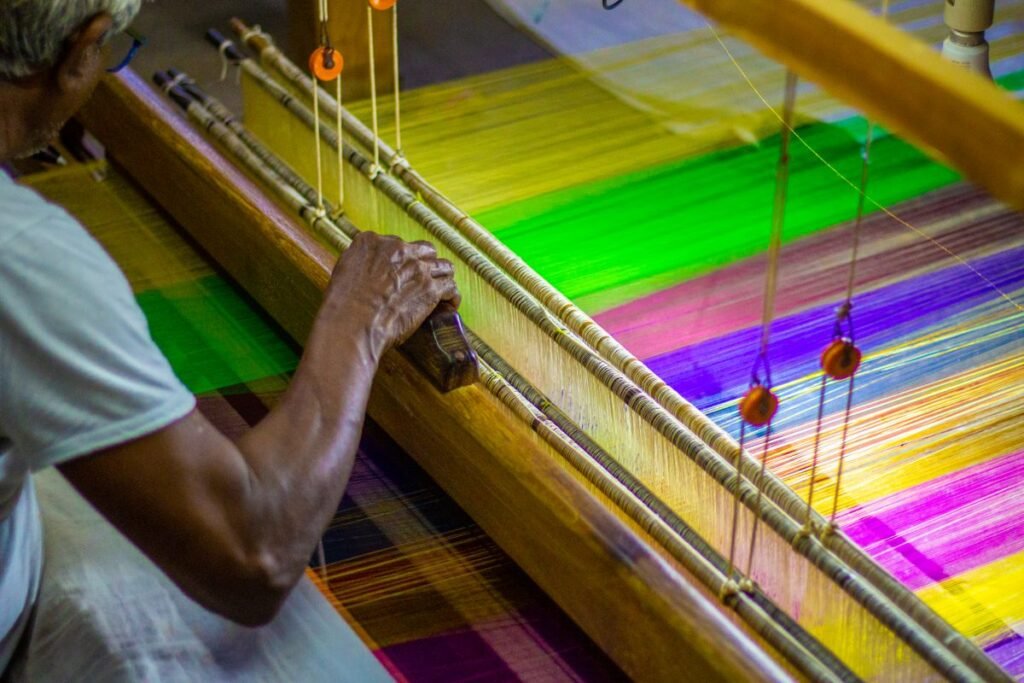
Meet the Handloom: The Machine Itself
A handloom looks simple, a frame, threads and a few moving parts, but every part has a job:
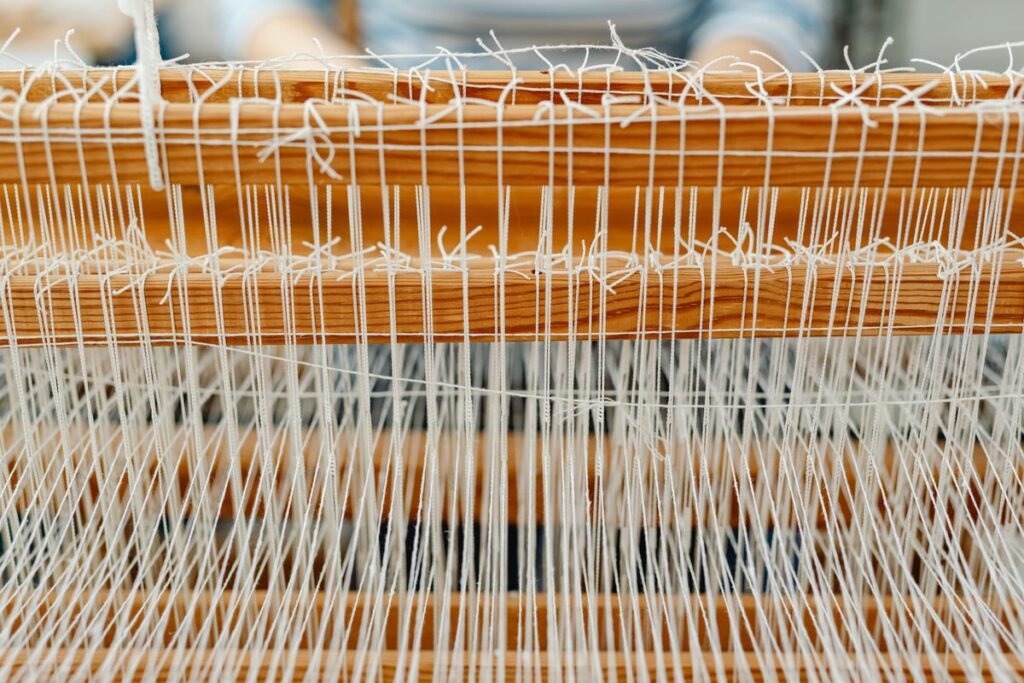
- Warp beam: the roller at the back that holds the warp, the lengthwise threads stretched under tension across the loom. These threads form the skeleton of the saree.
- Heddles and shafts: frames strung with vertical wires or cords, each with an eye through which one warp thread passes. Raising or lowering a shaft lifts its group of threads.
- Treadles: foot pedals under the loom, worked by the weaver’s feet, that raise and lower the shafts in sequence.
- Shuttle: the boat-shaped carrier that holds the weft (crosswise) yarn and travels across the loom, laying one row, one “pick”, at a time.
- Reed: a comb-like frame that the weaver swings forward after each pick to beat the new weft row snugly against the woven cloth.
- Cloth beam: the front roller on which the finished fabric is wound as weaving progresses.
Two loom types dominate saree weaving. On a pit loom, common in Bengal and much of the South, the weaver sits at floor level with legs in a pit below, where the treadles are worked; the setup is stable and well suited to fine work. A frame loom is a free-standing wooden or metal frame, easier to install and move, used widely across India. Shuttles come in two styles too: the older throw shuttle, passed from hand to hand through the warp, slow and precise, and the fly shuttle, flicked across by a cord mechanism, which is faster. Both are still handlooms, because human muscle remains the only power source.
How Handloom Weaving Works, Step by Step
Weaving a saree begins long before the first row of cloth appears:
- Yarn preparation and dyeing. Hanks of yarn are washed and dyed in the colors the design needs, then dried. For patterned sarees, several colors of weft may be prepared for a single piece.
- Warping. The warp threads are measured out to the full length of the saree, often along a courtyard or street, in the exact count and color order the design requires, then wound onto the warp beam.
- Sizing. The warp is lightly coated with starch so the threads can survive thousands of rubs against the heddles and reed without snapping.
- Drafting and denting. Each warp thread, there can be several thousand, is passed by hand through a heddle eye and then through a gap in the reed. This threading alone can take days, and one mistake shows in the cloth.
- Weaving. Now the repeating cycle begins: the weaver presses treadles to lift a set of warp threads, opening a gap called the shed; throws or flies the shuttle through it, laying one weft pick; then pulls the reed forward to beat the pick into place. Shed, pick, beat, thousands of times per saree. Borders, pallu and motifs are not added later; they are woven in during this same cycle, with extra weft threads worked in wherever the pattern falls.
- Finishing. The saree is cut from the loom, inspected, washed or pressed, and folded. Small faults are corrected by hand where possible.
The time this takes depends entirely on complexity. A plain cotton saree may come off the loom in a day or two; a fine Jamdani, where every motif is inlaid separately by hand, can occupy weavers for weeks, our step-by-step account of how Jamdani sarees are made shows why that weave sits at the slow, skillful extreme of handloom work.
What Makes a Saree “Handloom”?
Pulling the threads together, a saree earns the handloom name when:
- Every weaving motion is human-powered, no motor drives the shedding, picking or beating.
- A weaver controls the cloth row by row, adjusting tension and pattern as it grows.
- The design, borders, pallu, motifs, is built into the weave itself, not printed or embroidered afterward.
- The work happens on a pit loom, frame loom or similar traditional loom, with or without dobby or jacquard patterning attachments.
One common confusion is worth clearing up: handloom is not the same as hand-spun. Khadi is the special case where the yarn is spun by hand and the cloth is woven by hand. Most handloom sarees use mill-spun yarn, and that does not make them any less handloom, the term has always described the weaving, not the spinning.
Famous Handloom Saree Traditions
Because the handloom is a tool rather than a style, “handloom saree” covers an enormous family of regional traditions, each with its own yarn, motifs and loom habits. Bengal gives us cotton Jamdani and Tangail, woven on pit looms with motifs inlaid or brocaded by hand. Varanasi’s Banarasi brocades use silk and zari with jacquard patterning, every motif still placed under a weaver’s control. Kanchipuram’s silk sarees interlock separately woven borders and pallus on the loom. Madhya Pradesh contributes Chanderi and Maheshwari; Odisha, tie-dyed Sambalpuri ikat; Gujarat, the double-ikat Patola that counts among the most demanding weaves in the world. Different fibers, different looks, the same human-powered principle underneath.
The Handloom Mark and India Handloom Brand
Because the word “handloom” sells, India runs two official labels to protect it. The Handloom Mark, introduced by the Government of India in 2006 and administered by the Textiles Committee under the Ministry of Textiles, certifies that a product is genuinely handwoven; tagged products carry a label with a traceable number. The India Handloom Brand, launched in 2015, goes a step further and certifies handloom products that also meet set quality standards for raw material, weave and dyeing. When you shop from the USA, these labels, or a seller who can explain exactly where and how a saree was woven, are the closest thing to a guarantee that “handloom” on the listing is fact, not decoration. India also celebrates National Handloom Day every year on 7 August.
How Handloom Cloth Feels, and Why It Costs What It Does
Handloom fabric has a character that comes directly from its making. Because a person, not a machine, sets the tension, the weave has tiny variations in density; motifs differ almost imperceptibly from one to the next; the selvedge can wander by a hair. Far from being defects, these are the fingerprints of handwork, and they give handloom cotton its soft, airy, slightly living feel against the skin. Mill-woven and powerloom cloth, made at high speed under machine tension, is more uniform and often flatter and stiffer, cheaper to produce, but without that texture.
The cost difference has the same root: time. Setting up a loom takes days before weaving starts, and a handloom produces a few meters of cloth a day at most, against many times that from a powerloom. When you pay more for a handloom saree, you are paying for a skilled weaver’s days, warping, threading, and thousands of shed-pick-beat cycles, and that is also why the purchase keeps weaving families and clusters employed.
Simple Signs of a Genuine Handloom Saree
No single test is foolproof, but a few quick observations help. Hold the fabric to the light: slight variations in density are normal in handloom. Run a finger along the selvedge: a handloom edge is rarely ruler-straight. Turn the saree over: hand-inlaid motifs show floats or neatly cut thread ends on the reverse, while a print looks flat and faded from behind. Compare repeated motifs: handwoven ones differ subtly. The same reverse-side and zari logic is walked through in detail in our guide on how to identify an original Banarasi saree. And check for the Handloom Mark where it is offered.
Frequently Asked Questions
Q: What is the difference between handloom and handwoven?
Nothing, in practice. “Handwoven” describes cloth woven by hand; “handloom” names the loom it was woven on. The two words are used interchangeably for sarees. Terms to watch instead are “handloom look” or “handloom finish,” which usually describe powerloom cloth made to resemble the real thing.
Q: Is every cotton saree a handloom saree?
No. Cotton names the fiber; handloom names the loom. A cotton saree can be handloom, powerloom or mill-woven, and most inexpensive cotton sarees are machine-made. If the loom matters to you, look for an explicit handloom statement or the Handloom Mark.
Q: Does handloom mean the yarn is hand-spun?
No. Handloom refers only to the weaving. Most handloom sarees are woven from mill-spun yarn. Cloth that is both hand-spun and hand-woven has its own name, khadi, and its own slightly uneven, textured character.
Q: How long does it take to weave a handloom saree?
It ranges from a day or two for a plain cotton saree to several weeks for a motif-dense Jamdani, and longer still for the most complex silk brocades. Loom setup, warping and threading thousands of warp ends by hand, adds days before weaving even begins.
Q: What is the Handloom Mark?
It is a Government of India certification label, introduced in 2006 and run by the Textiles Committee, that identifies a product as genuinely handwoven. The related India Handloom Brand, launched in 2015, also certifies quality standards for materials, weaving and dyeing.

Conclusion
A handloom saree is, at its core, a saree that a person wove, warp stretched on a wooden or metal frame, shuttle flying or thrown by hand, every row beaten into place by human rhythm rather than a motor. That single fact explains everything else about it: the soft, slightly irregular texture, the motifs woven into the cloth itself, the days or weeks behind a single piece, and the price that reflects a weaver’s skilled time. Once you know what the word really means, and what the Handloom Mark certifies, you can read any saree listing with new eyes and choose the real thing with confidence.