
 Image credit: Pexels
A silk saree looks effortless when it is draped, but almost nothing about how it is made is quick. Before a weaver sits down at the loom, the silk has already passed through farming, harvesting, reeling, twisting, degumming and dyeing, and each of those stages has its own specialists. This guide explains how silk sarees are made, step by step, from the silkworm that spins the fibre to the final inspection of the finished saree.
- Step 1: Sericulture, Raising the Silkworms
- The Main Types of Silk Used in Sarees
- Step 2: Reeling, Unwinding the Cocoon
- Step 3: Throwing and Degumming, Making Yarn
- Step 4: Dyeing the Yarn
- Step 5: Warp Preparation and Designing the Pattern
- Step 6: Weaving on the Handloom
- Step 7: Finishing and Quality Check
- Frequently Asked Questions
- Conclusion
Step 1: Sericulture, Raising the Silkworms
Silk production begins with sericulture, the farming of silkworms. The workhorse of the industry is Bombyx mori, the caterpillar of the domesticated silk moth, a species so thoroughly bred for silk that it no longer survives in the wild. A female moth lays hundreds of eggs, which hatch into larvae after about ten days.
For the next 25 to 30 days, the larvae are fed continuously on mulberry leaves, the sole food of Bombyx mori, in rearing houses where temperature and humidity are carefully controlled. When fully grown, each larva spins a cocoon around itself from a single continuous protein filament secreted from its glands. That filament has two components: fibroin, the strong core that becomes the silk fibre, and sericin, a natural gum that coats and holds the cocoon together. Both names matter later in the process.
Once the cocoons are complete, they are harvested and stifled, exposed to heat or steam, to kill the pupa inside. Stifling is essential for reeled silk: if the moth were allowed to emerge, it would break the single filament into short pieces. The cocoons are then sorted by colour, size and quality.

The Main Types of Silk Used in Sarees
Not all saree silk comes from Bombyx mori. India works with four commercially important silks, and the type of silk changes how the yarn is prepared:
| Silk | Silkworm | Food plant | Character |
|---|---|---|---|
| Mulberry | Bombyx mori (fully domesticated) | Mulberry leaves | The finest, smoothest and most lustrous silk; the standard for Kanjivaram and Banarasi sarees |
| Tussar (tasar) | Antheraea species (wild/semi-wild) | Oak, arjun, asan and other forest trees | Coarser texture, less lustrous, naturally tan to golden in colour |
| Eri | Samia ricini | Castor leaves | Matte, warm and durable; the cocoon is open-ended, so the silk is spun like cotton rather than reeled |
| Muga | Antheraea assamensis | Som and soalu trees (Assam) | Naturally golden-yellow and glossy; prized for Assamese sarees and mekhela chadors |
Mulberry silk accounts for the great majority of the world’s silk and nearly all of its fine sarees. Eri is the exception in processing: because its cocoon has no single continuous filament to unwind, it is carded and spun into yarn instead, which is also why eri silk can be harvested after the moth emerges, earning it the name “peace silk.” Our guide to different saree fabrics explained covers how these silks feel and drape once woven.
Step 2: Reeling, Unwinding the Cocoon
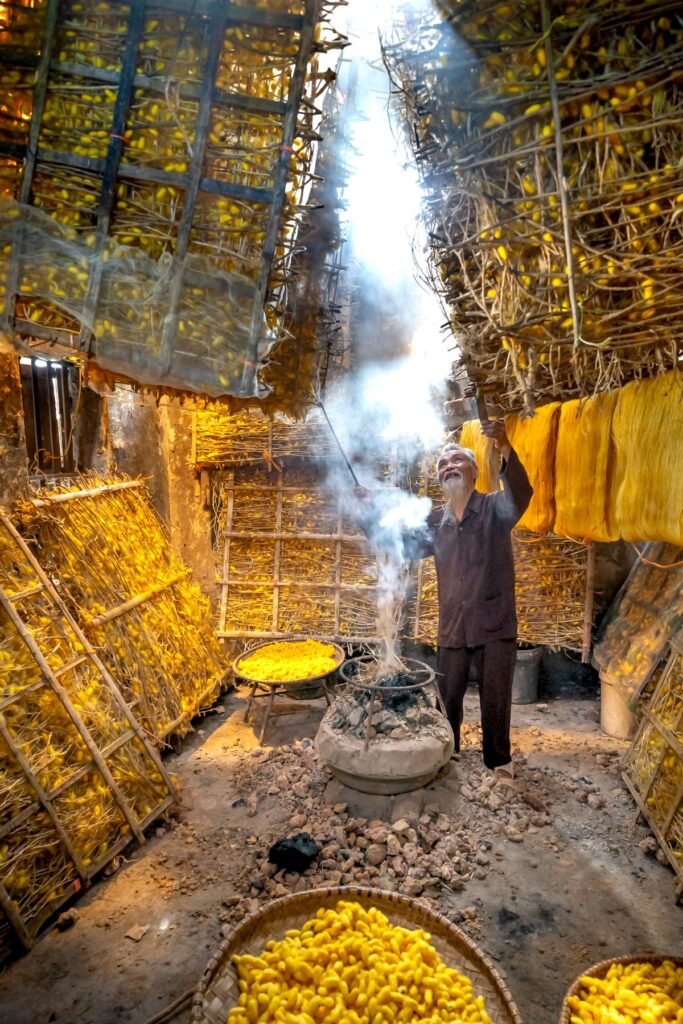
Reeling is the extraction of the filament. The sorted cocoons are placed in hot water, which softens the sericin gum so the end of the filament can be found and lifted. A single cocoon contains roughly 1,000 to 1,500 metres of filament, but that filament is far too fine to use alone. So the reeler draws the filaments from several cocoons, typically four to eight at a time, through a small guide eye and onto a reel, where they combine into one thread of raw silk, lightly held together by their own sericin.
The numbers explain why silk is precious: it takes on the order of a few thousand cocoons to produce half a kilogram of raw silk. Reeling is done on simple hand-turned charkas, in cottage basins, or on multi-end and automatic reeling machines, and the evenness of the reeler’s work decides the uniformity of the yarn.
Step 3: Throwing and Degumming, Making Yarn
Raw silk thread is not yet weaving yarn. In a process called throwing, the reeled threads are wound, doubled and twisted together. The amount and direction of twist creates different yarns: a high-twist warp yarn (traditionally called organzine) gives the fabric strength and body, while a softer, low-twist weft yarn (tram) keeps the surface smooth. Katan, the classic Banarasi base fabric, is simply silk yarn that has been twisted in this way.
At some point before or after throwing, the silk is degummed: boiled in a soap or mild alkaline bath to strip away the sericin. Degumming removes roughly a quarter of the yarn’s weight and transforms it, the dull, stiff, gummy raw silk becomes soft, smooth and lustrous, and ready to take dye evenly. This is the moment silk starts to look like silk.
Step 4: Dyeing the Yarn
Silk sarees are almost always woven from yarn that has already been dyed, because the body, border, pallu and motifs each need their own colours in the weave itself. The degummed yarn, in skeins, is soaked to make it receptive, then immersed in dye baths, sometimes repeatedly to build depth of colour. Both natural dyes (from plants, flowers and minerals) and synthetic dyes are used; synthetic dyes are commoner today for their consistency and fastness. Dyed skeins are dried in the shade so the colour does not fade, then wound onto bobbins and pirns for the loom. The whole dyeing and preparation stage can take several days.
Step 5: Warp Preparation and Designing the Pattern
Weaving starts with the warp, the lengthwise threads that form the foundation of the saree. Thousands of warp threads are measured out to the full length of the saree (plus the weavers’ allowance), kept in exact order, and wound onto the loom’s warp beam. For a saree with a contrasting border, the border warps are prepared in their own colours alongside the body warp.
At the same time, the design is drafted. Traditional patterns were held in the weaver’s memory and counted out thread by thread; today, designs are typically worked out on graph paper first, each square representing threads, and for jacquard looms the pattern is punched into a chain of cards that will control which warp threads lift on each pass of the shuttle. Setting up a loom for a new design can take days before a single row is woven.
Step 6: Weaving on the Handloom
Most fine silk sarees are woven on handlooms, frequently pit looms, where the weaver sits with legs in a pit below the loom, working the treadles with the feet to lift sets of warp threads while the hands throw the shuttle carrying the weft. Each pass of the shuttle lays one row; the pattern grows line by line.
Two patterning methods define India’s great silk sarees:
- Brocade and zari work. In Banarasi weaving, extra weft threads of silk and zari, metallic thread traditionally made by wrapping flattened silver (gilded with gold) around a silk core, are inserted only where the motif falls, building raised gold-and-silver patterns into the cloth. In the kadhua method each motif is woven separately, leaving no floating threads on the reverse.
- Interlocked construction. In Kanchipuram weaving, body, border and pallu are woven with separate shuttles and interlocked (korvai for the border, petni for the pallu), so a single saree may need two weavers working one loom.
Other regions weave silk differently again: Bengal’s Jamdani, for instance, builds its motifs with a discontinuous weft on a pit loom, in silk and half-silk as well as cotton, see our explainer on what a Jamdani saree is for that technique. Depending on complexity, weaving one silk saree takes from several days for a simple piece to weeks or even months for a dense bridal weave.
Step 7: Finishing and Quality Check
Off the loom, the saree is not yet finished. Loose thread ends are trimmed, and the cloth is washed, stretched and pressed or rolled to settle the weave and bring out an even sheen. The fall and blouse piece are cut where the design requires it, and the saree is examined carefully, held up and checked for broken threads, uneven dye, misaligned motifs and weaving flaws. Only pieces that pass inspection are folded, labelled and packed. In India, genuine silk sarees may carry the Silk Mark label, issued by the Silk Mark Organisation of India under the Central Silk Board, certifying that the fabric is natural silk.
Frequently Asked Questions
Q: How long does it take to make one silk saree?
The weaving alone takes from several days for a simple saree to weeks or months for an intricate bridal piece, and the stages before it, rearing the silkworms for about a month, reeling, dyeing and setting up the warp, add considerably more time. A plain silk saree might be woven in about a week; a complex brocade can occupy a loom for a month or longer.
Q: How many cocoons does it take to make a silk saree?
Thousands. A single cocoon yields roughly 1,000 to 1,500 metres of filament, but the filaments are combined and much is lost in processing; as a rule of thumb, a few thousand cocoons are needed for half a kilogram of raw silk, and a heavy silk saree uses several hundred grams of silk.
Q: What is the difference between mulberry, tussar, eri and muga silk?
They come from different silkworm species feeding on different plants. Mulberry silk, from the domesticated Bombyx mori fed on mulberry leaves, is the finest and most lustrous. Tussar comes from wild Antheraea moths and is coarser with a natural golden-tan colour. Eri, from the castor-fed Samia ricini, is matte and warm and must be spun rather than reeled. Muga, from Assam’s Antheraea assamensis, is naturally golden-yellow and glossy.
Q: What is degumming in silk production?
Degumming is the removal of sericin, the natural gum that coats raw silk, by boiling the yarn in a soap or mild alkaline bath. It removes roughly a quarter of the yarn’s weight and is what turns dull, stiff raw silk into the soft, lustrous fibre that takes dye evenly.
Q: Are all silk sarees woven by hand?
No. India’s celebrated sarees, Kanjivaram, Banarasi, Jamdani and others, are traditionally handwoven on pit or frame looms, and handloom weaving is part of their definition and GI protection. But a large share of the silk sarees sold today are woven on powerlooms, which is why labels such as the Handloom Mark and Silk Mark exist to identify how a saree was made and what it is made of.

Conclusion
How silk sarees are made is really a chain of crafts: the sericulturist who raises Bombyx mori larvae on mulberry leaves for a month; the reeler who unwinds several cocoons at once into a single thread; the throwster who twists that thread into strong, dye-ready yarn; the dyer; and finally the weaver who interlaces warp, weft and zari on a handloom, row by row, for days or weeks. Understanding that chain, and details like degumming, kadhua brocade and korvai interlocking, makes it far easier to judge the quality of any silk saree you hold in your hands.