
 Image credit: Pexels
Banarasi silk and Kanjivaram silk are the two most celebrated silk saree traditions in India, and they are often the final two names on a wedding shopper’s list. Both are handwoven, both use real zari, and both carry Geographical Indication (GI) protection. Yet they are built in almost opposite ways: a Banarasi is defined by brocade pattern woven across the whole cloth, while a Kanjivaram is defined by heavy mulberry silk and a contrasting border interlocked into the body. This guide compares Banarasi silk vs Kanjivaram silk on origin, silk, weaving technique, borders and pallu, motifs, weight, drape and price character, so you can tell them apart and choose the right one.
Banarasi vs Kanjivaram: Quick Comparison
| Feature | Banarasi Silk | Kanjivaram Silk |
|---|---|---|
| Origin | Varanasi (Banaras), Uttar Pradesh | Kanchipuram, Tamil Nadu |
| Design heritage | Mughal and Persian-influenced brocade | South Indian temple art and architecture |
| Silk used | Fine mulberry silk; katan, organza (kora), georgette and other bases | Pure mulberry silk only, traditionally high-twist and three-ply in the warp |
| Signature technique | Extra-weft brocade; motifs woven into the fabric, often with jacquard-guided patterning | Korvai: body and border woven with separate warps and interlocked; petni join for a contrast pallu |
| Zari placement | Across the entire body, border and pallu | Concentrated in the wide contrast border and pallu |
| Classic motifs | Floral butis, jaal (net), kalga and bel vines, meenakari, asharfi (coin) | Temple gopuram borders, peacock, annapakshi, rudraksha, checks and stripes |
| Weight and drape | Lighter; soft, fluid drape | Heavier; stiff, structured drape that holds its shape |
| GI status | “Banaras Brocades and Sarees” registered in 2009 | Kanchipuram silk recognised in 2005–06 |
| Classic occasion | North Indian weddings, receptions and festive wear | South Indian weddings, temple occasions and formal ceremonies |
Origin and Heritage
The Banarasi comes from Varanasi, one of the oldest continuously inhabited cities in the world, in the northern state of Uttar Pradesh. Its silk weaving flourished under Mughal patronage, which is why its design language is full of Persian-influenced florals, vines and paisleys. According to Wikipedia’s overview of the Banarasi sari, the “Banaras Brocades and Sarees” GI registration of 2009 covers six districts, Varanasi, Mirzapur, Chandauli, Bhadohi, Jaunpur and Azamgarh, and only sarees woven in that region may legally be sold as Banarasi.
The Kanjivaram (also spelled Kanjeevaram) comes from Kanchipuram, a temple town in Tamil Nadu in the south, where the weaving tradition is more than 400 years old and is associated with the Devanga and Saliyar weaver communities. Its imagery is drawn from temple sculpture and Dravidian architecture rather than court art. The Kanchipuram silk sari was recognised as a Geographical Indication by the Government of India in 2005–06, earlier than the Banarasi registration.
The Silk Itself
A traditional Kanjivaram is uncompromising about its raw material: pure mulberry silk, and nothing else. The warp yarn is traditionally made by twisting three silk filaments together, which gives the finished cloth its density, strength and characteristic firmness. There are no traditional georgette or organza versions of a Kanjivaram, the heaviness is part of the definition.
Banarasi weaving is more varied. The classic bridal base is katan, a fabric woven from twisted pure silk threads, prized for its smooth surface and durability. But the same brocade tradition is also worked on organza (called kora, a sheer, crisp base), georgette and a fabric called shattir. By design, Banarasi sarees are grouped into families such as Jangla, Tanchoi, Cutwork and Butidar. This variety is one reason the Banarasi covers a wider range of weights and looks than the Kanjivaram.
Weaving Technique: Brocade vs Korvai
This is the deepest difference between the two. A Banarasi is a brocade: supplementary weft threads, silk and metallic zari, are inserted during weaving to build raised patterns directly into the cloth. Traditional Banarasi looms are hand-operated pit looms, with jacquard mechanisms and pattern cards guiding the intricate designs. In the finest kadhua technique, each motif is woven individually, so there are no loose thread floats running across the back of the fabric; in the faster fekwa method, the extra thread travels the width of the cloth and the floats between motifs are cut away afterwards. The body, border and pallu of a Banarasi are woven as one continuous piece.
A Kanjivaram is assembled differently. In the korvai technique, the body and the border are set up on separate warps in contrasting colours and interlocked thread by thread as weaving proceeds, producing a join so strong that weavers say the fabric may tear before the joint does. The work traditionally uses three shuttles, one for the body and one for each border, and can need two weavers sitting at the same loom. Where the pallu is a different colour from the body, it is attached with a related warp-wise interlock called petni, visible up close as a fine zigzag line across the width of the saree.
Borders, Pallu and Motifs
Because the techniques differ, the design logic differs too. On a Kanjivaram, the drama is concentrated at the edges: a wide, often temple-style border in a boldly contrasting colour, and a richly worked pallu that may be a third colour again. The body between them is comparatively restrained, plain, or patterned with checks, stripes or small woven buttas. Classic motifs come from temple walls and nature: gopuram (temple tower) borders, peacocks, the mythical annapakshi bird, parrots, rudraksha beads and mango shapes.
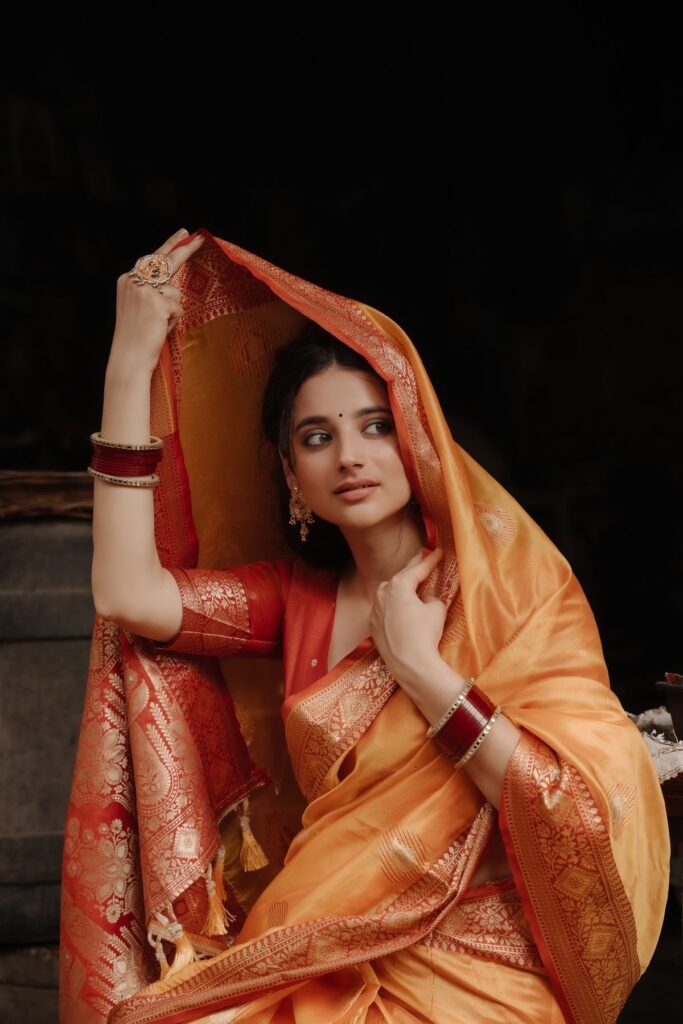
On a Banarasi, the richness is spread across the whole surface. Gold and silver brocade covers body, border and pallu alike, in Mughal-inspired patterns: small floral butis scattered over the field (butidar), dense vine networks called jaal or jangla, paisley forms (kalga), creepers (bel), coin-like asharfi motifs, and meenakari work, where coloured silk threads are woven into the zari motifs to add touches of colour. If you want a broader view of how the Banarasi’s brocade compares with another great figured weave, our guide to Jamdani vs Banarasi sarees looks at the two side by side.
Weight and Drape
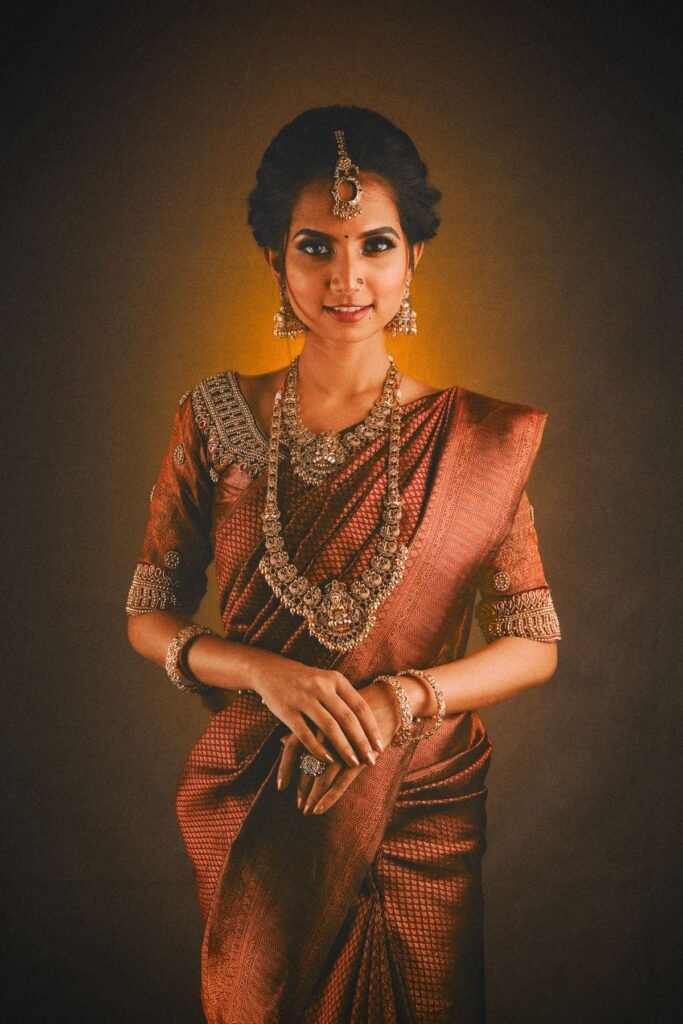
Weight is the difference you feel first. A traditional Kanjivaram commonly weighs roughly 800 grams to 1.2 kilograms, thanks to its dense three-ply silk and heavy zari borders. It drapes with structure: pleats fall sharp, hold their shape for hours, and the saree has an almost architectural presence. A Banarasi is generally lighter, typical handwoven pieces are cited around 400 to 900 grams, and light tanchoi or organza versions weigh less still. It drapes fluidly, falling in softer folds that move with the wearer.
A quick test used by sellers captures it well: hold a Kanjivaram up and it almost stands on its own; hold up a Banarasi and it flows and falls. Neither is better in the abstract, the Kanjivaram’s body is what makes it so durable and formal, while the Banarasi’s fluidity makes it easier to wear for long events.
Price Character
Neither saree is a budget purchase, and in both cases the price is driven mainly by the same three things: the purity and weight of the silk, whether the zari is real (silver thread gilded with gold, traditionally wound on a silk core) or tested/imitation zari, and the hours of handloom work in the piece.
The character of the ranges differs, though. The Banarasi spans the wider range: lighter organza, georgette and cutwork pieces sit at the accessible end, while dense kadhua bridal weaves with all-over jaal work are heirloom pieces at the top. The Kanjivaram’s floor is set higher by its materials, a genuine piece always carries a heavy weight of pure mulberry silk and substantial zari, so even an entry-level traditional Kanjivaram represents a significant amount of raw silk. In both traditions, a Silk Mark label is the standard assurance that the fibre is genuine silk.
When to Choose Which
- Choose a Kanjivaram if you want a structured, formal drape that holds its pleats all day, bold contrast borders, and a saree built to be kept and handed down. It is the classic choice for South Indian weddings and temple ceremonies.
- Choose a Banarasi if you want all-over ornate patterning, a lighter and more fluid drape, and more variety of base fabrics and weights. It is the classic choice for North Indian weddings, receptions and festive occasions.
- For long events in warm weather, a lighter Banarasi (organza or tanchoi) will usually be more comfortable than a full-weight Kanjivaram.
- For heirloom value, both qualify, a kadhua Banarasi and a korvai Kanjivaram are each at the top of their own tradition.
How to Tell Them Apart in Person
- Pick it up. The Kanjivaram feels noticeably heavier in the hand; its silk yarn is thicker.
- Look at the border join. A Kanjivaram’s contrast border meets the body in a fine interlocked line (korvai) with no colour bleeding across; a Banarasi’s border is woven continuously with the body.
- Check the pallu join. A contrasting Kanjivaram pallu shows the slight zigzag of the petni join; a Banarasi pallu flows on without a join.
- Read the motifs. Temple towers, peacocks and rudraksha checks point to Kanchipuram; floral jaals, vines and paisleys point to Varanasi.
- Turn it over. On a kadhua Banarasi, motifs are individually woven with no floats between them; on a Kanjivaram, the interlocked border join is visible on the reverse.
Frequently Asked Questions
Q: What is the main difference between Banarasi and Kanjivaram silk?
The main difference is construction. A Banarasi is a brocade, zari and silk patterns woven across the whole cloth in one continuous piece, while a Kanjivaram is built from heavy pure mulberry silk with a contrasting border and pallu interlocked into the body using the korvai and petni techniques. In short, Banarasi is about all-over pattern; Kanjivaram is about structure and contrast.
Q: Which is heavier, a Banarasi or a Kanjivaram saree?
The Kanjivaram is heavier. A traditional Kanjivaram commonly weighs about 800 grams to 1.2 kilograms because of its dense three-ply mulberry silk and heavy zari borders. Banarasi sarees are generally lighter, typically around 400 to 900 grams, and light organza or tanchoi versions weigh even less.
Q: Which is more expensive, Banarasi or Kanjivaram?
Both are premium handloom sarees, and top-end bridal pieces of either kind are heirloom purchases. The Banarasi covers a wider overall range because it is also woven in lighter bases such as organza and georgette, while a genuine Kanjivaram always contains a heavy weight of pure mulberry silk, which sets its starting point higher. In both cases, real gold-and-silver zari and slower techniques such as kadhua raise the price most.
Q: How can you tell a Banarasi from a Kanjivaram in person?
Weigh it in your hands first, the Kanjivaram is noticeably heavier. Then look at the border: a Kanjivaram’s contrast border is interlocked into the body with a fine korvai join, and a contrast pallu shows a zigzag petni join, while a Banarasi is woven in one continuous piece. Finally, read the motifs: temple towers and peacocks indicate Kanjivaram; floral jaals and paisleys indicate Banarasi.
Q: Which is better for a wedding, Banarasi or Kanjivaram?
Both are classic bridal sarees. Choose a Kanjivaram for a structured drape, dramatic contrast borders and South Indian wedding traditions; choose a Banarasi for all-over brocade richness, a softer and lighter drape, and North Indian wedding traditions. Comfort over a long day is the practical tiebreaker, if you are unused to heavy sarees, a lighter Banarasi is easier to wear for many hours.

Conclusion
Banarasi silk vs Kanjivaram silk is not a contest with one winner; it is a choice between two different kinds of excellence. The Banarasi, from Varanasi, wraps the whole saree in Mughal-inspired brocade on a relatively light, fluid silk. The Kanjivaram, from Kanchipuram, builds a heavier, structured drape from pure mulberry silk, with its drama concentrated in interlocked contrast borders and pallus drawn from temple art. Decide by the feel you want, flowing ornament or architectural structure, and both will reward you with a genuine piece of India’s handloom heritage. For a wider tour of the subcontinent’s great weaves, see our overview of the different types of sarees.