
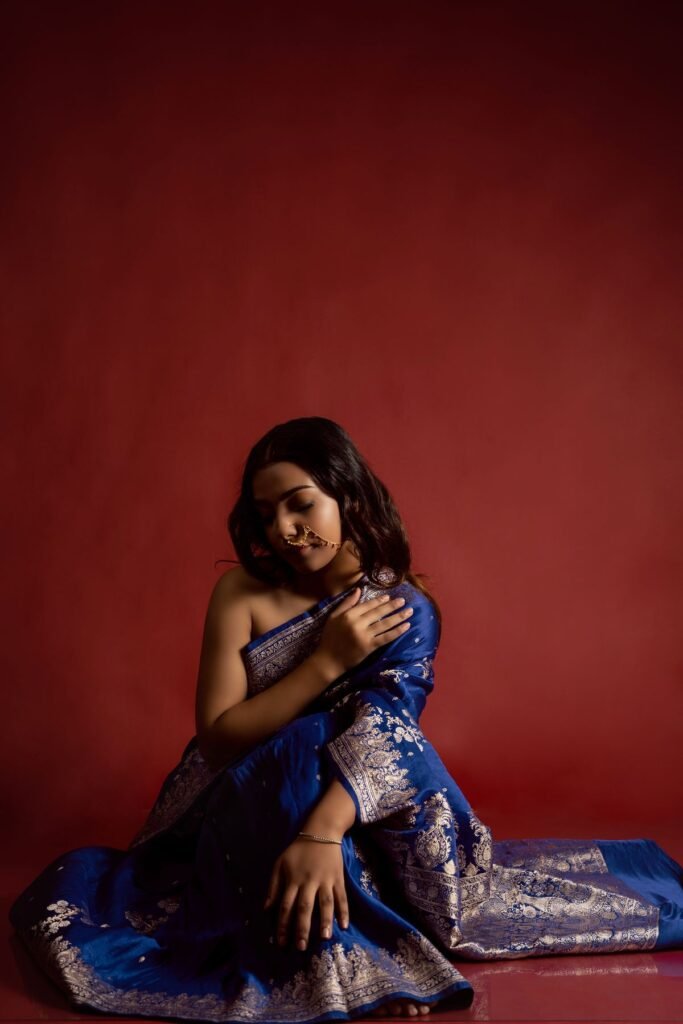
 Image credit: Pexels
A Banarasi saree is a silk saree woven in Varanasi, the ancient city in northern India also known as Banaras or Benares, and decorated with brocade in gold and silver thread, called zari. It is not a type of silk and not a print or embroidery style: “Banarasi” names where the saree is made and the weaving tradition it belongs to. The patterns are built into the cloth on the loom itself, which is why a Banarasi feels richer and heavier than an ordinary silk saree, and why it has been the classic Indian wedding saree for centuries.
This guide explains what a Banarasi saree is in plain terms: where it comes from, what it is made of, the motifs and types you will see in shops, how long one takes to weave, and how it differs from the other great handloom saree it is most often compared with, the Jamdani.
- Banarasi Saree at a Glance
- Where Banarasi Sarees Come From
- A Short History
- The Silk: Why “Banarasi Silk” Is a Slight Misnomer
- Zari and Brocade: Where the Shine Comes From
- Signature Motifs
- Types of Banarasi Sarees
- How Long Does One Take to Weave?
- Banarasi vs Jamdani: The Difference That Matters
- Frequently Asked Questions
- Conclusion
Banarasi Saree at a Glance
- What it is: a silk saree from Varanasi, Uttar Pradesh, defined by zari brocade woven directly into the fabric.
- The silk: usually mulberry silk, most classically as katan, a cloth woven from twisted pure silk yarn. There is no separate fibre called “Banarasi silk.”
- The decoration: brocade, an extra, decorative weft of zari (metal-wrapped thread) or coloured silk worked into the ground cloth during weaving.
- Signature motifs: intertwining florals and foliage, paisleys (kalga), creeping vines (bel), and a fringe of upright leaves (jhallar) along the border’s outer edge.
- Recognition: “Banaras Brocades and Saris” received Geographical Indication (GI) protection in 2009; legally, only sarees woven in Varanasi and five neighbouring districts can be sold under the Banaras name.
- Time to weave: from about 15 days for a simpler design to six months for the most intricate work.

Where Banarasi Sarees Come From
Varanasi, on the banks of the Ganges in the state of Uttar Pradesh, has been a textile city for centuries. The Banarasi weaving belt extends beyond the city into the surrounding districts, Mirzapur, Chandauli, Bhadohi, Jaunpur and Azamgarh, and the wider region’s handloom silk industry supports a large community of weaver families, many of whom have worked at the loom for generations.
The geography is not just background colour; it is legally part of the definition. When weaver associations secured GI rights for “Banaras Brocades and saris” in 2009, the registration tied the name to those six districts. A saree woven anywhere else, however similar it looks, cannot legally be sold as a Banaras saree in India. For a buyer in the United States, the GI tag is best understood as proof of origin, it says where a saree was woven, not how, so it sits alongside, rather than replaces, questions about handloom weaving and pure silk.
A Short History
Brocade weaving with gold and silver threads became the speciality of Banaras during the Mughal period, when the imperial court prized richly patterned silk. The craft deepened in the 17th century as silk weavers migrated from Gujarat, tradition links their arrival to the famine of 1603, and Persian-origin weaver families brought their own pattern vocabulary with them. The result was a fusion that still defines the Banarasi look: Persian and Mughal floral forms, paisleys and hunting scenes woven by Indian hands in Indian silk.
Through the 18th and 19th centuries the weaving reached its peak of refinement, and Banarasi sarees became standard wear for weddings and important occasions, traditionally paired with the wearer’s best jewellery. The craft later came under pressure from mechanised mills producing lookalike sarees faster and more cheaply, and from synthetic substitutes for silk, one reason the GI registration and handloom revival efforts of recent decades matter to the weaving families who keep the tradition alive.
The Silk: Why “Banarasi Silk” Is a Slight Misnomer
Ask a Varanasi weaver what silk a Banarasi is made from and you may get a gentle correction: there is no separate silk called Banarasi silk. The fibre is almost always mulberry silk, the smooth, lustrous silk produced by the domesticated silkworm, the same silk used in Kanjivaram and Mysore sarees, with tussar silk used for some pieces.
What the familiar Banarasi names actually describe is how that mulberry silk yarn is prepared and woven. Katan is the classic base: a durable cloth woven from twisted pure silk yarn, giving the saree its structure and sheen. Kora, the silk used for organza Banarasis, is left crisper and more sheer. Georgette and tissue Banarasis use still other yarn preparations. So when a listing says “Banarasi silk,” read it as shorthand for “a silk saree in the Banarasi tradition,” and check the fibre and base cloth separately if those details matter to you.
Zari and Brocade: Where the Shine Comes From
The gleam of a Banarasi is zari, thread made by wrapping a fine strip of metal around a silk core. Traditional zari used real gold and silver; museum pieces from Varanasi are described as woven with a yarn of silk thread wrapped in drawn gold. Today much zari is made with other metals or metallic coatings, which is one of the things that separates heirloom pieces from everyday ones.
Brocade is the technique that puts the zari into the cloth. Alongside the ordinary weft that builds the ground fabric, the weaver works in a supplementary weft, zari or coloured silk, that appears only where the design needs it, raising the pattern slightly above the surface. Nothing is printed or stitched on afterwards. When gold and silver zari appear together in the same motif, the combination is traditionally called Ganga-Jamuna, after the two great rivers. In the most labour-intensive method, kadwa, each motif is woven separately with its own shuttle, so no loose threads float across the back of the cloth; the reverse of a kadwa saree looks almost as clean as the front.

Signature Motifs
Banarasi design has a vocabulary of its own, inherited from Mughal court textiles. The motifs you will meet most often are:
- Kalga, the paisley or mango motif, the single most recognisable Banarasi form, traditionally associated with fertility and abundance.
- Bel, a flowing creeper or vine that carries flowers across the body and borders of the saree.
- Jhallar, a string of upright leaves along the outer edge of the border, a characteristic finishing detail.
- Jaal, a net-like lattice of intertwined flowers and foliage covering the field.
- Mina (meenakari) work, touches of coloured silk set inside zari motifs, like enamel in jewellery, adding small points of colour to the gold.
Peacocks, lotus flowers and other auspicious forms appear alongside these. If you want to go deeper into how to read motifs and borders, our guide to saree designs and patterns explains the shared design language of traditional sarees.
Types of Banarasi Sarees
Banarasi sarees are classified in two ways at once: by the fabric base, and by the design family. A single saree can be, for example, a katan saree in a jangla design.
By Fabric Base
- Katan (pure silk), the classic Banarasi: smooth, structured, lustrous, and the base most bridal pieces use.
- Organza (Kora), sheer and crisp, with zari and silk work on a transparent ground; lighter to wear.
- Georgette, fluid and comparatively light, with Banarasi borders and motifs on a flowing base.
- Shattir, a finer, more ornate brocade base, traditionally counted among the premium varieties.
- Tissue, woven with a high proportion of zari so the cloth itself shimmers like metallic tissue.
By Design Family
- Jangla, the most opulent layout: dense, all-over floral and vine work covering the body of the saree, with little ground cloth showing through. Among the oldest and most labour-intensive designs, and a bridal favourite.
- Butidar, small individual motifs (butis) scattered evenly across the field, with the ground silk visible between them. Balanced, versatile and the most wearable of the classic layouts.
- Tanchoi, a satin weave in which the pattern is made with coloured silk wefts rather than zari, giving a smooth, jewel-toned surface with an almost quilted density and a clean back.
- Shikargah, “hunting ground” designs: elephants, deer, tigers, birds and hunters woven into narrative scenes drawn from Mughal court art. Rare, collectible and among the most demanding patterns to weave.
- Cutwork, brocade in which the loose pattern threads on the back are trimmed away after weaving, leaving a cleaner, lighter reverse; a more approachable route to a handwoven look.
How Long Does One Take to Weave?
Depending on the intricacy of the design, a handwoven Banarasi can take from 15 days to a month, and the most complex pieces up to six months. A simple katan with scattered butis moves relatively quickly; a dense jangla or a kadwa piece, where every motif is placed individually, sits at the other end of the scale. Power-loom versions are produced in a fraction of the time and are also sold under the Banarasi name, which is why two sarees that look similar in a photograph can sit in very different price brackets, the difference is in the loom, the fibre and the hours.
Banarasi vs Jamdani: The Difference That Matters
The comparison most shoppers eventually make is with Jamdani, the handwoven saree of Bengal. Both are prestigious handlooms whose patterns are woven in, never printed, but they are built in opposite ways. A classic Jamdani is a fine, sheer cotton (or half-silk) ground in which each motif is inlaid separately by hand, so the pattern seems to float on a translucent surface and the saree stays remarkably light. A Banarasi builds its design in silk brocade: the zari pattern threads are worked across a rich, opaque silk ground, giving weight, structure and a metallic glow.
In short: Jamdani is airy and matte-elegant, Banarasi is dense and luminous. We compare the two in detail, weave, weight, price character and which occasions suit each, in our guide to Jamdani vs Banarasi sarees.
Frequently Asked Questions
Q: Is Banarasi a type of silk?
No. Banarasi is a place and a weaving tradition, the sarees of Varanasi, not a fibre. The silk itself is usually mulberry silk (occasionally tussar), prepared in different ways to produce bases such as katan, kora organza and georgette.
Q: What is zari in a Banarasi saree?
Zari is the metallic thread that creates the gold and silver patterns. Traditionally it was made by wrapping drawn gold or silver around a silk core; much modern zari uses other metals or metallic coatings. It is woven into the cloth as a supplementary weft during brocade weaving, it is never embroidery applied afterwards.
Q: How long does it take to weave a Banarasi saree?
Anywhere from about 15 days for a simpler design to six months for the most intricate handwork, depending on the density of the pattern and the technique used. Individually woven kadwa motifs and dense jangla layouts take the longest.
Q: What is the difference between a Banarasi and a Jamdani saree?
A Banarasi is a silk saree from Varanasi whose patterns are brocaded in zari across an opaque silk ground, rich, structured and relatively heavy. A Jamdani, from Bengal, inlays each motif separately by hand into a sheer cotton or half-silk ground, so it is light and translucent with motifs that appear to float. Both are handwoven; the weave, fibre and feel are entirely different.
Q: How can you tell if a Banarasi saree is genuine?
Start with origin and fibre: a GI tag supports that the saree comes from the Banaras region, and a Silk Mark tag supports that the fibre is natural silk, but neither proves handloom weaving on its own. Look for the small irregularities that hand weaving produces, check the reverse side (individually woven kadwa work has no long floating threads), and buy from a seller who can tell you who wove the saree and how long it took.
Conclusion
A Banarasi saree is what happens when one city’s weavers spend centuries perfecting a single idea: silk made splendid by patterns woven into the cloth itself, in gold and silver thread. Knowing what the name really means, Varanasi, mulberry silk, zari brocade, and design families from scattered butidar to dense jangla and narrative shikargah, makes the sarees much easier to shop for, whether you are choosing a bridal heirloom or your first handloom silk. Look for the woven-in pattern, ask about the base cloth and the technique, and the saree in front of you will tell you most of what you need to know.