
 Image credit: Pexels
A Jamdani saree is made entirely by hand on a wooden pit loom, and its patterns are never printed, embroidered, or added afterward. Every motif is woven into the cloth at the very moment the fabric itself is being made, using a technique called the discontinuous weft. That one fact explains almost everything about Jamdani: why its motifs seem to float on a sheer background, why no two pieces are ever perfectly identical, and why a fine saree can take months to finish.
Most traditional Jamdani is woven in villages around Dhaka in Bangladesh, especially in the Narayanganj area along the Shitalakshya River, in places such as Rupganj and Sonargaon. The craft grew out of the region’s celebrated muslin tradition, which is covered in more depth in our history of the Jamdani saree in Bangladesh. In 2013, UNESCO inscribed the traditional art of Jamdani weaving on its Representative List of the Intangible Cultural Heritage of Humanity.
Here is how the process works, from raw yarn to finished saree.
- Step 1: Preparing the Yarn
- Step 2: Setting Up the Warp and the Pit Loom
- Step 3: Weaving the Ground Cloth
- Step 4: Adding the Motifs, The Discontinuous Weft Technique
- Patterns from Memory and Graph Paper
- Two Weavers at One Loom
- Finishing the Saree
- Why a Jamdani Saree Takes So Long
- Frequently Asked Questions
- Conclusion
Step 1: Preparing the Yarn
Everything starts with fine cotton yarn. Traditional Jamdani is woven in yarn counts roughly in the 40 to 120 range, far coarser than the legendary Dhaka muslins of the past, but still fine enough to produce a light, translucent cloth. Silk yarn is used for silk and half-silk versions.
The yarn is dyed first, in the colors the finished design will need. Dyeing comes before weaving, because every thread, ground and pattern alike, must already be the right color when it reaches the loom.
Next, the dyed yarn is soaked, traditionally overnight, in a solution of rice-water starch. The starch strengthens and softens the thread at the same time, which matters because fine yarn breaks easily under loom tension. After soaking, the yarn is wound onto bobbins and small spools. In weaving households this winding is painstaking work, often done in the early morning hours when the air is still cool and humid, before the heat of the day dries the thread and makes it brittle and hard to handle.
Humidity is a quiet partner in the whole craft. Fine cotton threads snap less in moist air, which is one reason the monsoon months were traditionally prime weaving season for the finest cloth.

Step 2: Setting Up the Warp and the Pit Loom
Once the yarn is ready, the warp, the set of lengthwise threads that form the foundation of the saree, is prepared on a warp beam. This is a separate job, often done by a different worker from the weaver. Hundreds of fine threads must be measured, ordered, and wound evenly, because any unevenness at this stage will show in the finished cloth.
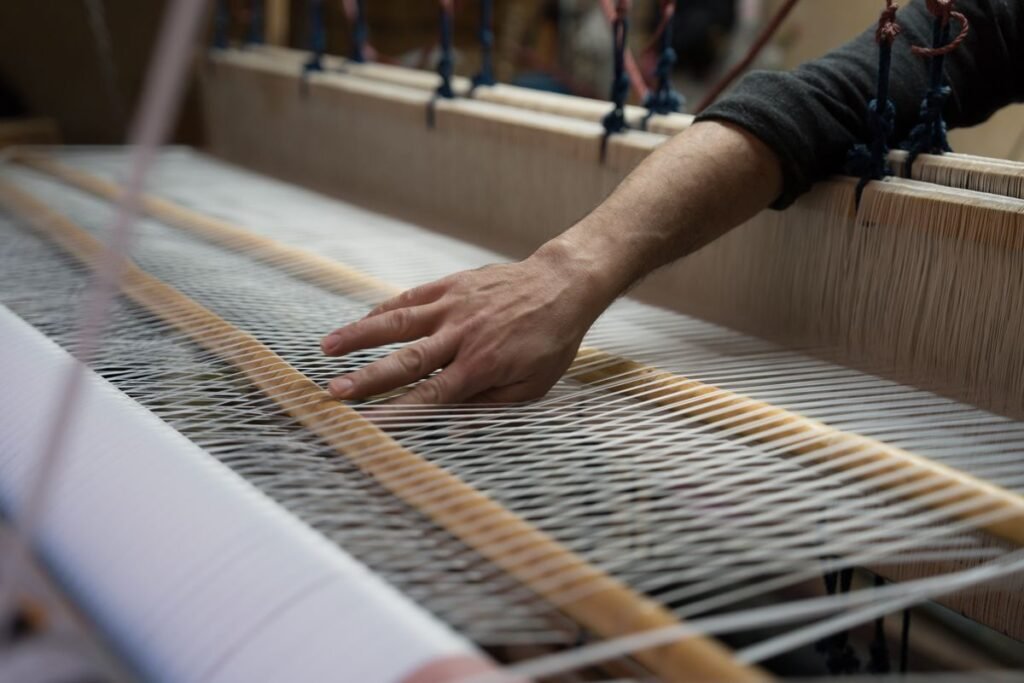
The warp is then taken to the weaver’s home or workshop and mounted on the loom. The traditional Jamdani loom is a pit loom: the weaver sits with legs in a pit dug into the floor, which keeps the loom at a comfortable working height and helps maintain steady tension. The loom itself is simple, a wooden frame with no jacquard, no punched cards, and no mechanism for lifting pattern threads automatically. Older looms used a throw shuttle; many weavers now use a fly shuttle for the ground weft, which is faster but still guided entirely by hand.
This simplicity is the point. Everything a jacquard loom would do mechanically, the Jamdani weaver does manually, thread by thread.
Step 3: Weaving the Ground Cloth
Weaving begins with the ground fabric, the sheer base of the saree. In a classic cotton Jamdani, the base is woven with unbleached cotton yarn, while the motifs are worked in bleached or colored yarn, creating a subtle light-and-dark contrast.
The weaver passes the shuttle across the full width of the warp to lay the standard weft, beats it into place, and repeats. This part of the work is similar to any plain handloom weaving: a steady rhythm of shed, shuttle, and beat-up that slowly builds the translucent ground cloth.
On its own, this ground would be a plain, gauzy fabric. What turns it into Jamdani is what happens next, row by row, at the same time.
Step 4: Adding the Motifs, The Discontinuous Weft Technique
Jamdani’s defining technique is the discontinuous supplementary weft. Alongside the standard weft that runs the full width of the cloth, the weaver works with a second, separate thread for the pattern, usually a slightly thicker thread of cotton, silk, or zari (metallic thread).
The key word is discontinuous. The pattern thread does not travel from one edge of the saree to the other. It is inserted only where a motif belongs: the weaver interlaces it in and out of the warp threads across the few centimeters that the flower, diamond, or paisley will occupy, and then it stops. The next motif is built the same way, as a separate little island of thread.
To do this, the weaver uses a small pointed tool of bamboo or horn, often called a kandul, to lift individual warp threads and pass the pattern thread through by hand. Each motif color is carried on its own small spool, so a multicolored design means many spools in play at once, each picked up and set down in turn.
Because the pattern threads never run across the whole width, there are no long floats of thread on the back of the cloth between motifs. Turn a handwoven Jamdani over and you will see the same motifs on the reverse, slightly rougher, with nothing connecting them. That clean reverse side is one of the clearest signs of genuine handwoven Jamdani, and it is also why the motifs look as if they are floating on the sheer ground.
Patterns from Memory and Graph Paper
There is no printed pattern on the cloth and no mechanical guide on the loom. Traditionally, designs were held entirely in the weaver’s memory, passed down through families, a master weaver carries a repertoire of motifs such as buti (small flowers), kalka (paisley), vines, diamonds, and geometric borders, and knows how each one is counted out in warp threads.
For newer or more complex designs, a drawing is prepared first, the design is worked out on graph paper, where each square corresponds to threads on the loom, and a translucent copy may be placed underneath the warp as a visual guide while weaving. Even then, the drawing only guides; the weaver still counts threads and builds every motif by hand, and experienced weavers often adjust or improvise as they go.
This is why handwoven motifs are never perfectly identical. One flower may sit a thread higher than its neighbor, or a diamond may be a fraction wider. Those small irregularities are not flaws; they are the signature of the process.

Two Weavers at One Loom
A Jamdani loom is usually worked by two people sitting side by side: a master weaver and an assistant, traditionally called a jugali. The master directs the work, handles the most demanding parts of the pattern, and keeps the overall design on count. The assistant weaves the simpler sections and motifs on their side of the cloth and helps maintain the rhythm of the ground weave.
Working in pairs saves time and makes intricate, wide patterns manageable, two sets of hands can build motifs on different parts of the row simultaneously. It is also how the craft is taught: assistants learn the motifs and the counting by weaving alongside a master, long before they direct a loom of their own.
Finishing the Saree
When the weaving is complete, the cloth is cut from the loom and the finishing begins. The saree is washed gently to remove the starch and any loom dirt, then dried. A light starch may be applied again to give the sheer cotton its characteristic crispness and help it hold pleats.
The fabric is then pressed or ironed, the edges and the pallu (the decorative end piece) are checked, and loose threads are tidied. Finally, the saree is inspected, held up to the light, where the fine ground and any weaving faults become easy to see, before it is folded and sent to market.
Why a Jamdani Saree Takes So Long
Every stage described above is slow, but the real time goes into the motifs. A weaver might complete only a few inches of densely patterned cloth in a day, because each row of a design can involve dozens of individual thread insertions, each one counted and placed by hand.
As a general guide, a simple Jamdani with scattered small motifs may take around a week on the loom. A finely woven saree with dense, all-over patterning can take several months, and the most elaborate pieces can take up to a year. Finer yarn, more colors, and denser motifs all push the time upward, which is also the core of why Jamdani sarees are expensive compared with machine-made cloth.
Frequently Asked Questions
Q: How long does it take to make a Jamdani saree?
It depends on the fineness of the yarn and the density of the pattern. A simple Jamdani with scattered motifs may take about a week of weaving, while a dense, finely patterned saree can take several months, and the most elaborate pieces up to a year.
Q: What is the discontinuous weft technique?
It is the method that defines Jamdani. In addition to the normal weft that runs across the whole cloth, the weaver inserts a separate pattern thread by hand, but only within the area of each motif. The thread does not travel across the rest of the fabric, so each motif stands alone with no connecting threads on the back.
Q: Why do two weavers work on one Jamdani loom?
A master weaver and an assistant share the loom to manage wide, complex patterns and to keep the work moving, each can build motifs on a different part of the row at the same time. It is also the traditional way assistants learn the craft.
Q: What tools do Jamdani weavers use?
The main tool is the pit loom itself, a simple wooden frame with no pattern mechanism. For the motifs, weavers use a small pointed bamboo or horn tool called a kandul to lift individual warp threads, plus individual small spools for each pattern color, and a shuttle for the ground weft.
Q: Are Jamdani sarees really made entirely by hand?
Traditional handloom Jamdani, yes, the ground cloth is woven on a hand-operated pit loom and every motif is inserted manually, thread by thread. Machine-made fabrics in a Jamdani style also exist, but they are imitations: their pattern threads typically run across the back of the cloth rather than sitting as separate motifs.
Conclusion
A Jamdani saree is made the slow way on purpose: yarn is dyed, starched, and wound by hand; a warp of hundreds of fine threads is mounted on a simple pit loom; and then, row by row, two weavers build the pattern directly into the cloth using the discontinuous weft technique. Nothing is printed and nothing is stitched on afterward. Understanding that process makes the finished saree easier to appreciate, the floating motifs, the clean reverse side, and the slight irregularities are all direct results of how it was made.