
 Image credit: Pexels
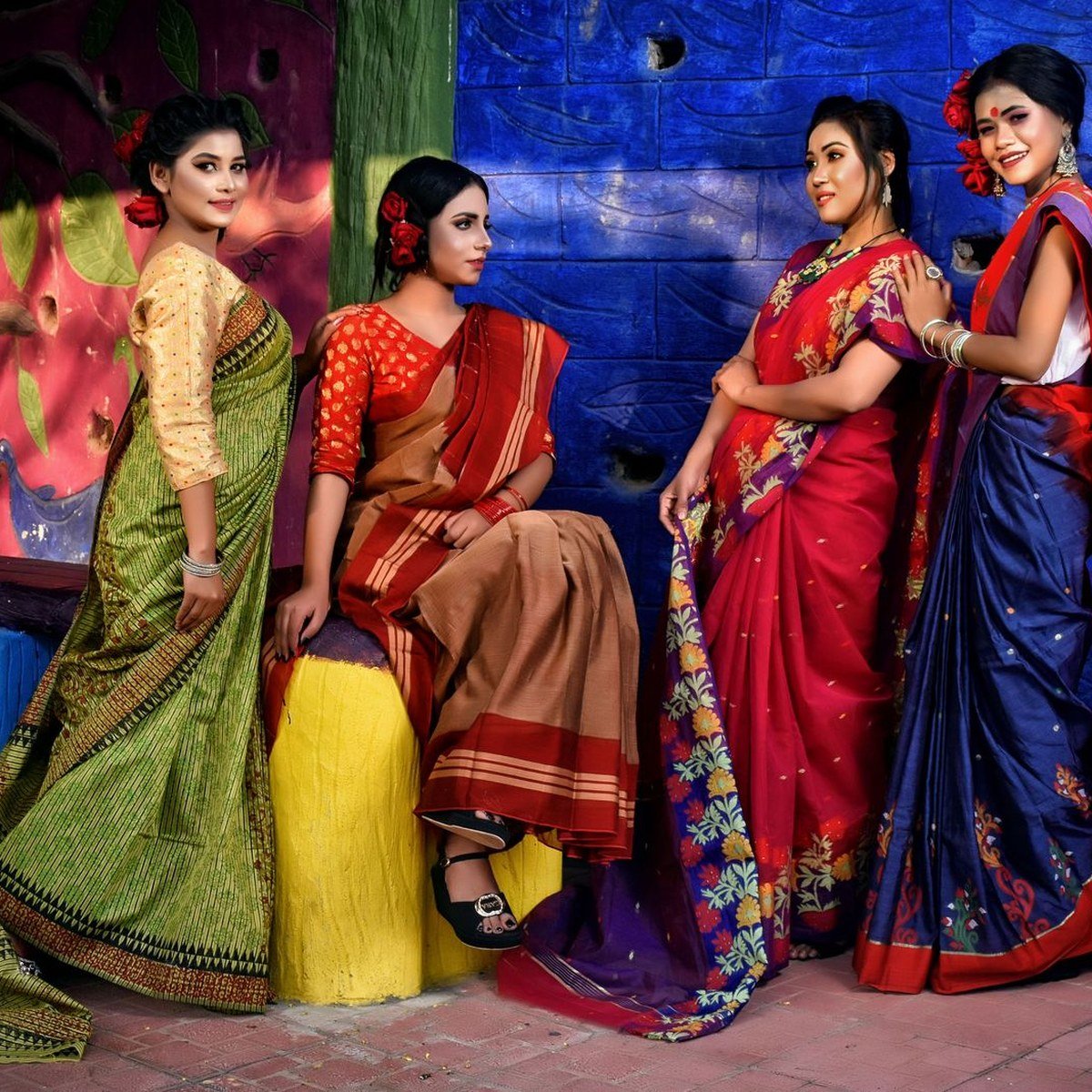
If you have ever searched for a saree online and felt buried under names, Banarasi, Kanjivaram, Bandhani, Patola, Jamdani, you are not alone. The different types of sarees number in the dozens, and there is no single official list. That is because a saree’s name can describe where it is woven, the weaving technique behind it, the surface craft applied to it, or simply the fabric it is made from. Once you understand those four naming habits, the whole map of saree types becomes much easier to read.
This guide walks through the major types region by region: the silk brocades of the north, the tie-dyes and ikats of the west, the temple silks of the south, and the handlooms of the east. It ends with a short note on where Bangladesh’s own saree traditions fit into the picture, since Bengal’s weaving heritage is shared across that border.
How Saree Types Get Their Names
Most saree names fall into one of four groups, and knowing which group a name belongs to tells you a lot before you ever see the fabric.
Place names tell you where the tradition comes from. Banarasi is woven in Varanasi, Kanjivaram in Kanchipuram, and Chanderi and Maheshwari in the Madhya Pradesh towns of the same names. Many of these names are protected by Geographical Indication (GI) registration, which ties the name to producers in that region.
Weave names describe how the pattern is built on the loom. Jamdani, ikat and brocade are weaves, so the same technique can appear in different places and in different fibers.
Technique names describe what is done to the cloth or yarn. Bandhani is tie-dyeing, kalamkari is hand painting or printing, and kantha is running-stitch embroidery worked across the surface.
Fabric names tell you the fiber and finish only: cotton, silk, chiffon, organza, net. These are the most useful words for everyday buying, because the fabric decides how a saree feels and drapes, whatever its regional name.
A single saree can carry several kinds of name at once. A Dhakai Jamdani, for example, is a place (Dhaka), a weave (jamdani) and a fabric (fine cotton) in one name. With that in mind, here are the types worth knowing, grouped by region.
North and Central India
Banarasi, Varanasi, Uttar Pradesh
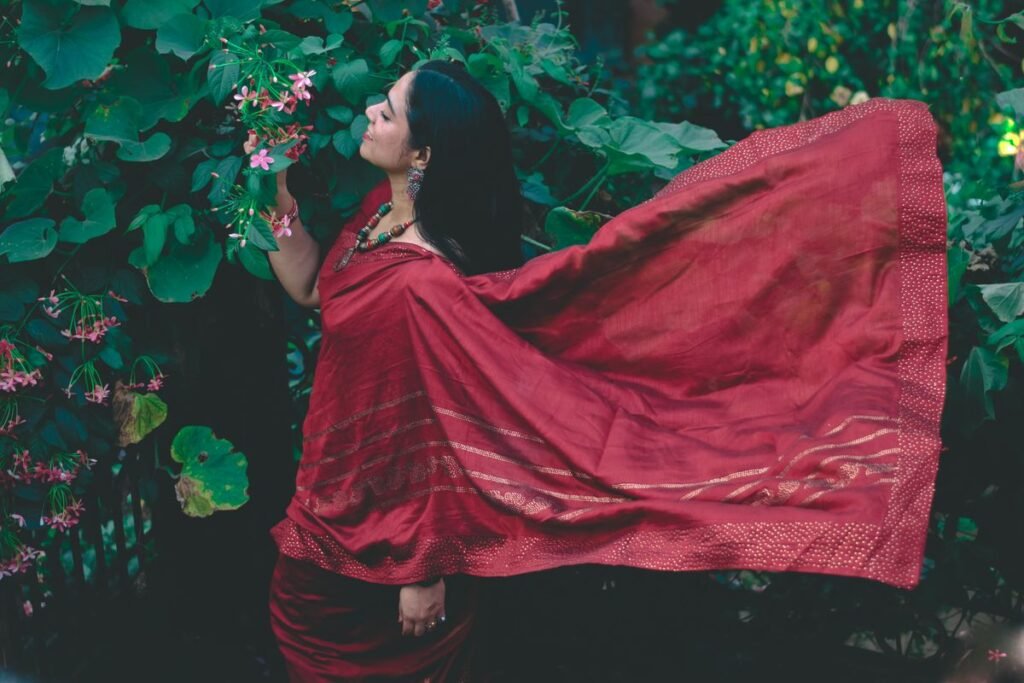
The Banarasi is India’s best-known wedding saree. Woven in Varanasi, traditionally in silk, it is defined by dense zari brocade: small butis (motifs) scattered across the body and larger floral and jaal (net-like) patterns with a clear Mughal influence. In the kadwa technique, each motif is woven in separately, which leaves the back of the cloth unusually neat. A Banarasi has a rich, structured drape and real presence, which is why it remains a first choice for brides and for the women of the family at weddings and receptions.
Because both are celebration textiles with motifs woven in by hand, shoppers often weigh a Banarasi against Bengal’s Jamdani before buying. Our Jamdani vs Banarasi comparison breaks down how the two differ in weave, weight and feel.
Chanderi, Madhya Pradesh
Chanderi is the opposite end of the scale: a light, slightly sheer silk-cotton (also woven in cotton or silk) with a soft sheen and small woven buttis. It feels airy even in warm weather and carries a slim, elegant border. Chanderi suits daytime functions, summer weddings and festive gatherings where a heavy silk would be hard work.
Maheshwari, Madhya Pradesh
Maheshwari sarees are traditionally woven with a silk warp and a cotton weft, which gives them a light body, a gentle sheen and simple stripes or checks. Many have a reversible border that looks finished on both sides. The tradition is linked to the patronage of the 18th-century ruler Ahilyabai Holkar. A Maheshwari is an easy, refined everyday saree that also dresses up well for small functions.
West India
Bandhani, Gujarat and Rajasthan
Bandhani is not a weave but a resist-dye craft. Thousands of tiny points of fabric are pinched and tied with thread before dyeing; when the ties are opened, they leave a field of small dots. Genuine bandhani is slightly puckered, and the dots have soft, uneven edges rather than a printed crispness. It is worked on cotton, silk and lighter fabrics, in the bright color combinations associated with festivals and celebrations in Gujarat and Rajasthan. The Gharchola, a Gujarati bridal staple, combines bandhani dots inside a woven grid of zari checks.
Patola, Patan, Gujarat
Patola is a double ikat silk saree from Patan. Both the warp and the weft threads are tie-dyed before weaving, so the weaver has to align dyed sections of yarn with great precision for the pattern to emerge. The result is a bold geometric or floral design that looks the same on both sides of the cloth, with slightly softened edges where the dyed threads meet. Double ikat is among the most labor-intensive weaving techniques anywhere, and a true Patan Patola is treated as an heirloom.
Paithani, Maharashtra
Paithani is Maharashtra’s bridal silk, woven with zari and known for its ornate pallu filled with peacock and parrot motifs and a border of oblique square designs. Body and border colors are often in contrast, and the silk can appear to shift tone as it moves. Like the Banarasi and Kanjivaram, it is a structured, formal saree chosen when the saree itself is the centerpiece of the outfit.
South India
Kanjivaram, Kanchipuram, Tamil Nadu
The Kanjivaram (also spelled Kanjeevaram or Kanchipuram) is the great silk of the south: heavy mulberry silk with a wide zari border in a contrasting color. Traditionally, the border and the pallu are woven separately and then interlocked with the body in the korvai technique, and you can sometimes see the join line where the colors meet. Temple borders, checks and stripes are classic design elements. A Kanjivaram is substantial, holds its pleats with authority, and is the standard bridal saree across much of South India.
Mysore Silk, Karnataka
Mysore silk is the lighter, smoother counterpoint to the Kanjivaram. It is a soft mulberry silk, often woven as a plain, lustrous body with a narrow gold zari border and little other ornament. It drapes more fluidly and is easier to wear for long events, pujas and elegant dinners where a very heavy silk is not needed.
Pochampally Ikat, Telangana
Pochampally is a single ikat tradition: either the warp or the weft is tie-dyed before weaving, producing crisp geometric patterns with a characteristic feathered edge. It is woven in both cotton and silk. Cotton Pochampally sarees are comfortable office and everyday wear, while the silk versions serve festive occasions.
East and Northeast India
Sambalpuri, Odisha
Sambalpuri sarees are woven in western Odisha using the bandha ikat technique, in which yarn is tie-dyed before it goes on the loom. Traditional motifs include conch shells, wheels, fish and flowers, worked in both cotton and silk. The patterns are graphic and clearly defined, and the cotton versions are practical, breathable everyday sarees.
Tussar Silk, Bihar, Jharkhand and Central India
Tussar is a wild silk with a naturally textured surface and a warm, gold-beige tone. It has a matte glow rather than the shine of mulberry silk, and it is lighter and less formal in feel. Bhagalpur in Bihar is its best-known weaving center. Tussar takes dye and hand painting well, so it is often seen with printed, painted or embroidered designs.
Muga Silk, Assam
Muga is the golden silk of Assam, produced nowhere else in the same way. Its yellow-gold color is natural, not dyed, and the sheen is said to deepen with wear and age. Muga is woven into sarees as well as into Assam’s traditional two-piece mekhela chador. Eri, the other Assamese silk, is matte, soft and warm, with a hand closer to cotton or fine wool.
Where Bangladeshi Saree Types Fit In
Bengal’s weaving traditions developed long before the modern border, and they are still practiced on both sides of it. Three Bangladeshi types deserve a place in any complete list.
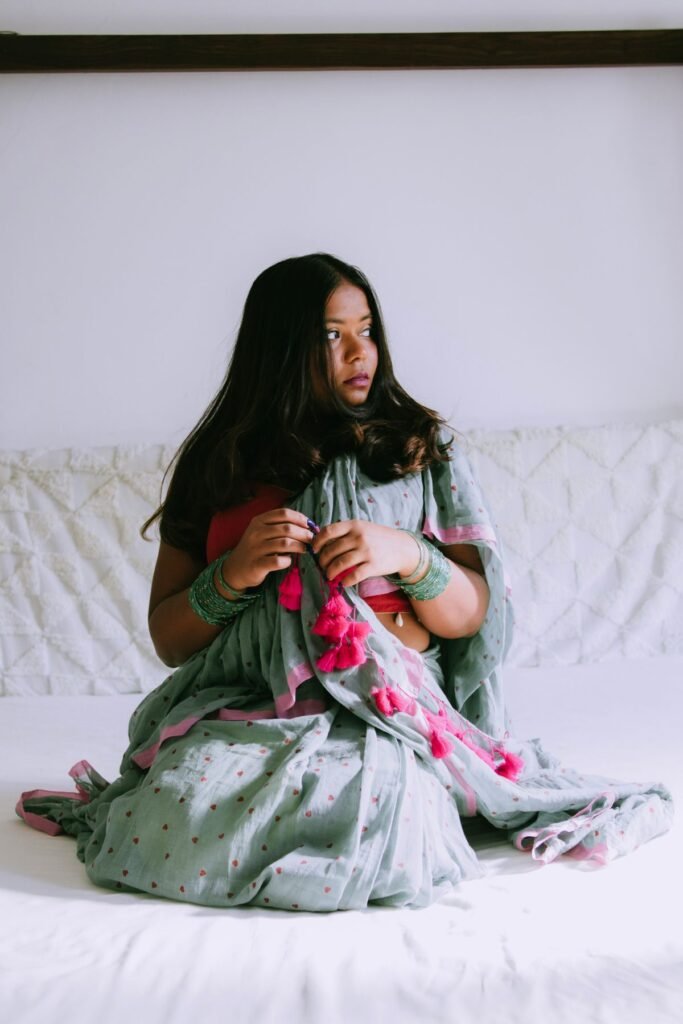
Jamdani is the most celebrated. Woven around Dhaka in fine cotton, and also in half-silk and silk, it is patterned with a discontinuous supplementary weft: the motifs are inlaid by hand during weaving, so they appear to float on the sheer ground and show through on the back. There is no print and no embroidery involved. UNESCO inscribed the traditional art of Jamdani weaving on its Representative List of the Intangible Cultural Heritage of Humanity in 2013.
Tangail sarees are handloom cottons from the Tangail region, known for fine, soft weaving, neat borders and everyday comfort in a hot, humid climate. Rajshahi silk, from the northwest of Bangladesh, is a soft mulberry silk used for smooth, lustrous sarees with a lighter feel than the heavy southern silks.
These three, along with half-silk Jamdani, muslin and others, get a fuller treatment in our guide to traditional Bangladeshi saree types.
Fabric-Named Types You Will See Everywhere
Alongside the regional names, US stores and marketplaces list many sarees by fabric alone. Organza sarees are crisp and sheer, holding a structured, floaty silhouette. Georgette and chiffon sarees are light and fluid, usually machine-made, and popular for parties and receptions. Net sarees are sheer mesh bases built to carry sequins and embroidery. These are fabric categories rather than regional traditions, and any of them can be printed or decorated in the style of a regional type, which is why a listing that says “Banarasi style” is describing a look, not the Varanasi original.
How to Choose Among the Types
For a wedding or a major festival, the heavy silks, Banarasi, Kanjivaram and Paithani, are the traditional choices, and they reward the occasion with structure and presence. For daytime events and warm weather, Chanderi, Maheshwari, cotton ikats and Tangail cottons are far easier to wear for hours. For a piece to keep and hand down, look at the slow weaves: Patan Patola, fine Jamdani and Muga. And for regular wear, the honest everyday cottons, Tant, Mangalagiri-style weaves and Pochampally cotton, are hard to beat.
Frequently Asked Questions
Q: What are the most popular types of sarees?
The names that come up most often are Banarasi, Kanjivaram, Bandhani, Patola, Chanderi, Paithani and Jamdani. Banarasi and Kanjivaram lead for weddings, Bandhani for festivals, and Jamdani and the cotton handlooms for regular and occasion wear in Bengal and Bangladesh.
Q: What is the difference between Banarasi and Kanjivaram sarees?
Banarasi comes from Varanasi in the north and is defined by zari brocade, motifs woven across the body in Mughal-inspired floral patterns. Kanjivaram comes from Kanchipuram in Tamil Nadu and is defined by heavy mulberry silk with a contrasting border and pallu that are woven separately and interlocked with the body. Both are formal wedding silks, but their construction and design language are quite different.
Q: Which saree types come from Bangladesh?
The best-known Bangladeshi types are Dhakai Jamdani, woven in fine cotton or silk with hand-inlaid motifs; Tangail handloom cottons; and Rajshahi silk. Jamdani weaving was inscribed by UNESCO on its Intangible Cultural Heritage list in 2013.
Q: Which type of saree is best for a wedding?
For a traditional wedding look, Banarasi, Kanjivaram and Paithani silks are the classic choices. For a daytime or summer wedding, a lighter Chanderi, a silk-cotton or a fine Jamdani gives a festive look without the weight of a heavy silk.
Q: How can you tell a handloom saree from a printed imitation?
Turn the fabric over. Woven patterns, brocade, jamdani and ikat, show on the back of the cloth, while a print is pale or absent on the reverse. Motif edges also help: ikat edges look slightly feathered, jamdani motifs sit raised on the surface without needle holes, and bandhani dots are softly puckered. A perfectly flat, razor-sharp repeat is usually a print.
Conclusion
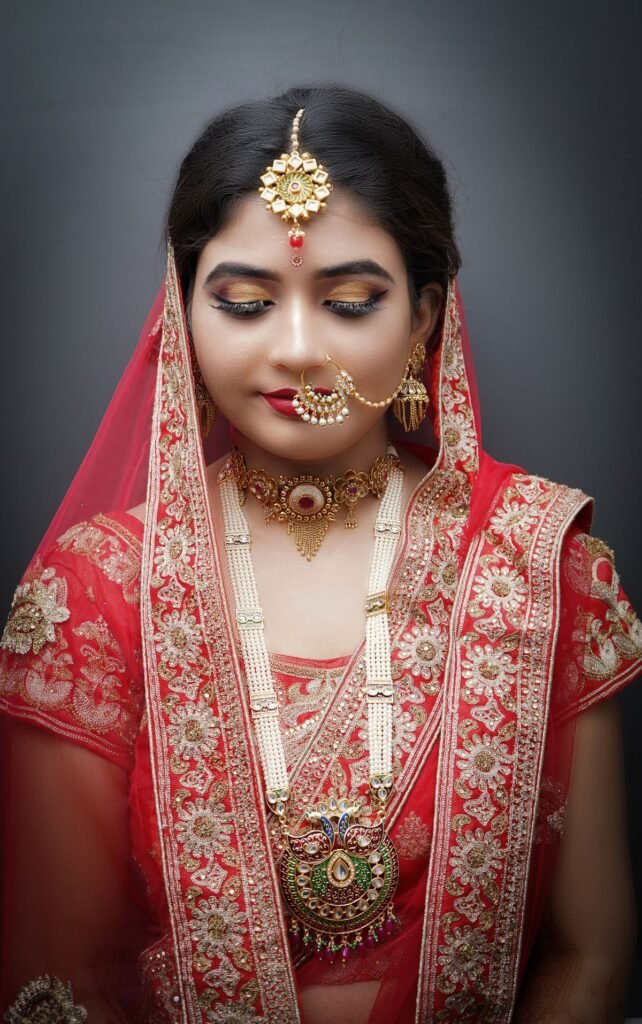
The different types of sarees make sense once you read the names properly: place, weave, technique or fabric. The regional handlooms, Banarasi, Kanjivaram, Patola, Bandhani, Chanderi, Jamdani and the rest, are distinct traditions with their own fibers, motifs and occasions, not interchangeable labels. Knowing which is which helps you choose a saree for the event you actually have, recognize genuine weaving when you see it, and appreciate why the slow, hand-worked types hold their value.