
 Image credit: Pexels
Indian and Bangladeshi sarees are the same garment, one long, unstitched cloth, draped and pleated, made by two weaving cultures that were a single region until 1947. That shared root is why the two are so often compared, and why the honest answer is more interesting than a simple contest: India developed dozens of regional silk traditions, while Bangladesh concentrated on the fine cotton handloom heritage of Bengal. The differences show up in the signature weaves, the fabrics, the motifs, and the price character.
Indian vs Bangladeshi Sarees at a Glance
| Feature | Indian sarees | Bangladeshi sarees |
|---|---|---|
| Signature weaves | Banarasi, Kanjivaram, Patola, Bandhani, Paithani, Chanderi | Jamdani, Tangail, Rajshahi silk, muslin |
| Best-known fabric | Silk, often with gold and silver zari | Fine cotton and cotton-silk handloom |
| Motif character | Mughal florals and jaal work; temple borders and peacocks in the south | Geometric and floral motifs woven to float on a sheer ground; bold Tangail borders |
| Overall feel | Ranges from light cottons to heavy, structured bridal silks | Generally lighter, softer, and more understated |
| Price character | Premium handloom silks sit at the top of the market | Strong value in handloom cotton; finest Jamdani is a luxury item |
| Flagship occasions | Weddings, Diwali and regional festivals | Weddings, Eid, Pohela Boishakh (Bengali New Year) |

One Garment, One Shared Bengal Root
Any honest comparison has to start with the overlap. Bengal, today split between Bangladesh and the Indian state of West Bengal, was one weaving culture for centuries. Jamdani, its most famous weave, developed around Dhaka and is now woven on both sides of the border, because many weaving families moved to West Bengal after Partition in 1947 and continued the craft there. The traffic runs both ways: the Banarasi-style silk saree, born in Varanasi, India, has also been woven in Bangladesh for over a century and is a staple of Bangladeshi weddings, with its own local color preferences.
So “Indian” and “Bangladeshi” describe centers of gravity, not sealed boxes. India’s saree map is a federation of regional styles, one per state or weaving town. Bangladesh’s is smaller and more unified, built around Bengali handloom cotton and the Dhaka muslin tradition.
Signature Weaves of India
Banarasi: Mughal brocade in silk and zari
The Banarasi saree comes from Varanasi in Uttar Pradesh and is defined by brocade: gold and silver metallic thread (zari) woven directly into fine silk. Its designs descend from Mughal-era art, floral sprays, scrolling vines, paisleys, and all-over net-like patterns called jaal. A Banarasi drapes more fluidly than most ceremonial silks, and its patterning covers the body as well as the border and pallu. It is India’s archetypal wedding saree in the north.
Kanjivaram: temple silk with interlocked borders
The Kanjivaram (Kanchipuram) saree of Tamil Nadu is built differently. Body and border are woven separately and then interlocked on the loom, the korvai technique, which allows the wide, boldly contrasting borders the style is known for. The silk is thick mulberry, the motifs come from temple architecture (gopuram towers), peacocks, and checks, and the finished saree is noticeably heavier and more structured than a Banarasi. It is the classic bridal silk of South India.
Beyond these two, India’s range keeps going: double-ikat Patola from Gujarat, tie-dyed Bandhani, peacock-motif Paithani from Maharashtra, featherlight Chanderi, and the everyday tant cottons of West Bengal. No single weave represents India the way one weave can represent Bangladesh.
Signature Weaves of Bangladesh
Jamdani: motifs woven into muslin-fine cotton
Jamdani is Bangladesh’s flagship. Woven on handlooms around Dhaka and Narayanganj, it uses a discontinuous supplementary-weft technique: the weaver inserts each motif by hand, only where the motif sits, so flowers, vines, and geometric patterns appear to float on a sheer, fine cotton ground. Nothing is printed or embroidered, and the motifs show on both sides of the cloth. In 2013, UNESCO inscribed the traditional art of Jamdani weaving of Bangladesh on its Representative List of the Intangible Cultural Heritage of Humanity. A dense, all-over Jamdani can take weeks of work by two weavers at one loom.
Tangail: the everyday handloom
Tangail sarees, from the Tangail district, are soft cotton handlooms known for their wide, colorful, decorated borders, with the patterning concentrated at the border and pallu and small motifs scattered on the body. They are less intricate than Jamdani, quicker to weave, and correspondingly more affordable, the saree Bangladeshi women actually live in, for ordinary days as much as festivals.
Rajshahi silk and the muslin legacy
Bangladesh also produces silk, notably from Rajshahi, in smoother, more understated styles than Indian bridal silks. Behind all of it stands the historical fame of Dhaka muslin, the extraordinarily fine cotton cloth of earlier centuries from which the Jamdani tradition grew. Our guide to traditional Bangladeshi saree types covers these weaves, and others such as Manipuri and Benarasi-style silks, in more depth.
Motifs and Design Language
Look at the patterns and the two traditions separate quickly. Indian ceremonial silks favor density and shine: Banarasi jaal covers the field with fine floral netting in metallic thread, and Kanjivaram borders carry temple towers and peacocks in broad bands of zari. The effect is ornate and architectural.
Bangladeshi Jamdani motifs are smaller in scale and airier in placement, single flowers, sprigs, vines, and precise geometry spaced across a translucent ground, so the cloth itself stays visible between motifs. Tangail shifts the emphasis to the border: a comparatively quiet body set off by a wide, brightly patterned edge. As a broad tendency, Indian festive sarees lean bolder and more metallic; Bangladeshi handlooms lean lighter and more restrained, with plenty of exceptions in both directions.
Fabric, Weight, and Feel
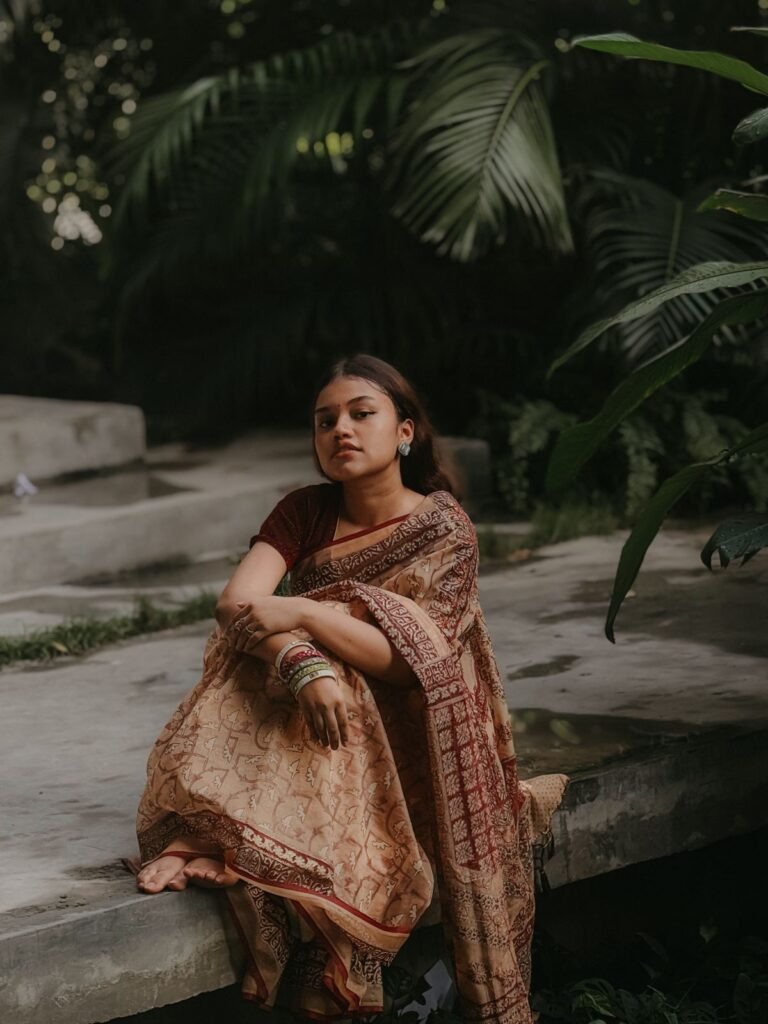
Climate explains much of this. Bengal is hot and humid, and its signature cloth evolved to breathe: fine cotton Jamdani and Tangail are light on the body and comfortable for long wear. India’s most famous sarees answer a different brief, the ceremony. Kanjivaram’s thick silk and Banarasi’s silk-and-zari brocade are built to look substantial for a wedding day, and they feel it: heavier, warmer, more formal. Both countries also weave the full range in between, including silk-cotton blends and everyday cottons, but the center of gravity differs, cotton handloom in Bangladesh, silk in India’s prestige weaves.
Price Character
Without quoting figures, handloom prices vary too much by maker and market for that to be honest, the pattern is consistent. India’s premium bridal silks occupy the top of the saree market: a genuine Kanjivaram or Banarasi in pure silk with real zari is a significant purchase, and priced like an heirloom. Bangladesh’s handloom sector is known for value: a well-made Tangail or mid-range Jamdani generally costs less than a comparable Indian handloom silk, which is one reason Bangladeshi sarees attract budget-conscious buyers abroad.
The exception proves the rule at the top end. A fine Dhakai Jamdani with dense, all-over motifs represents weeks of skilled labor and is priced accordingly, it competes with luxury textiles anywhere. What you are paying for on both sides is the same thing: handwork time.
Occasions
In India, the heavy silks belong to weddings, Banarasi in the north, Kanjivaram in the south, and silk sarees are bought new for Diwali and regional festivals, while cotton sarees handle daily life. In Bangladesh, brides traditionally wear Benarasi-style silk or a fine Jamdani, Jamdani is the prestige choice for Eid and formal events, and the red-and-white cotton saree is the emblem of Pohela Boishakh, the Bengali New Year. Tangail and other cottons cover the everyday. In both countries, the pattern is the same, cotton for the day, the finest weave you own for the celebration, only the flagship weaves differ.
How to Tell Them Apart
A few checks separate most Indian and Bangladeshi sarees in practice:
- Turn the cloth over. In handwoven Jamdani, each motif is woven separately, so the back shows the same motifs with no long threads running between them. Brocade such as Banarasi typically shows floats of metallic thread behind the pattern.
- Read the motifs. Temple towers, peacocks, and bold checks suggest Kanjivaram; Mughal florals and fine jaal suggest Banarasi; small floating flowers and geometry on a sheer ground suggest Jamdani; a quiet body with a wide, bright border suggests Tangail.
- Feel the fabric. Very light, slightly crisp, translucent cotton points to Bengal’s handlooms. Heavy, smooth silk with a structured fall points to India’s bridal silks.
- Check the border. A border in a strongly contrasting color that looks almost attached is a Kanjivaram signature (it is interlocked, not printed). A border that carries nearly all the pattern, on cotton, is characteristic of Tangail.
- Look for labels and GI tags. Several famous weaves on both sides carry Geographical Indication registration, Jamdani was Bangladesh’s first GI product, and reputable sellers state the weave and origin plainly.
For the two names buyers compare most often, our dedicated guide to Jamdani vs Banarasi sarees walks through the weave, weight, and wearing differences in detail.
Frequently Asked Questions
Q: Is Jamdani Indian or Bangladeshi?
Both, with a Bangladeshi heartland. Jamdani developed around Dhaka, in present-day Bangladesh, and UNESCO’s 2013 inscription recognizes Bangladesh’s tradition specifically. After Partition in 1947, weaving families also established the craft in West Bengal, India, where it continues today.
Q: Are Bangladeshi sarees cheaper than Indian sarees?
Generally, comparable Bangladeshi handloom cottons cost less than India’s premium handloom silks, and Bangladeshi sarees have a reputation for value. But the finest handwoven Jamdani is a luxury textile priced for the weeks of labor it takes, so the ranges overlap at the top.
Q: Which saree is best for a wedding, Indian or Bangladeshi?
It depends on the wedding and the wearer. Banarasi and Kanjivaram silks are the classic bridal choices in India. In Bangladesh, brides wear Benarasi-style silk or fine Jamdani. As a guest anywhere, a mid-weight silk or a good Jamdani is appropriate in both traditions.
Q: Do India and Bangladesh drape sarees the same way?
Mostly, yes, the Nivi drape (front pleats, pallu over the left shoulder) is common in both countries. Bengal also has its traditional atpoure drape, worn with wide borders displayed over both shoulders, which you will see at Bengali festivals on both sides of the border.
Q: What is the most famous saree from each country?
India has two strong candidates: the Banarasi of Varanasi and the Kanjivaram of Tamil Nadu. Bangladesh’s most famous saree is unambiguously the Jamdani of Dhaka, followed by the everyday Tangail.
Conclusion
Indian and Bangladeshi sarees are branches of one tradition that grew in different directions. India multiplied its regional silks, Banarasi brocade, Kanjivaram temple silk, and dozens more, while Bangladesh refined the fine cotton handloom heritage of Bengal into Jamdani and Tangail. Neither is “better”; they answer different climates, occasions, and budgets. Learn to read the weave, the motifs, and the back of the cloth, and you can tell at a glance which tradition a saree comes from, and appreciate why both have lasted.